


Messy Handwriting in Kids: Working Out What's Behind It

Messy handwriting in kids has more than one possible cause. The same smudgy page can come from a child who isn't sure how to form the letters, a child who knows the shapes but can't control the pencil yet, a child who can't judge size and spacing, a child who is racing, or a child who is simply worn out by the third sentence. Each of those needs a different response.
So the most useful first step is working out which kind of messy you're looking at. After that, the research I've seen is fairly consistent about what helps: practice that is actually handwriting, aimed at the specific problem. General hand-strengthening alone doesn't seem to carry over to writing, though an OT may still recommend targeted work for a child whose hands tire from weakness.
One age note first. For preschoolers and many kindergartners, wobbly, oversized, reversed and inconsistent letters are expected while hand skills and letter knowledge are still developing. This guide is mostly for children who are in school and writing regularly. If you're parenting a four-year-old, a messy page is usually just a four-year-old's page.
Why is my child's handwriting so messy?
Put a page of their writing in front of you and sort what you see. Messy writing often involves more than one of these:
- Letter shapes: odd starting points, letters left open that should close, a, d and g that all look alike.
- Size: letters that wander between tiny and huge, or capitals dropped into the middle of words.
- Spacing: words that run together, or gaps you could park a car in.
- Line placement: letters floating above the baseline or sinking below it.
- Pressure: gouging the paper, or lines so faint they're hard to read.
- Speed: a neat first line that turns into a scrawl.
Jot down the two or three that show up most. That short list will point you more reliably than the word "messy" does.
How can you tell what's causing it?
You can't diagnose anything at the kitchen table, and an evaluation looks at things you can't see from a page. But a few quiet observations can help you form a hunch to share with a teacher or OT. None of these are validated tests, and each one can point more than one way. They help you describe what you see to a teacher or OT. They don't replace an evaluation.
Copying versus writing from memory. Ask for a short sentence copied from a model, then a word or two written after hearing it. If the letters hold up when copying but fall apart when your child has to recall the shape, the letter plan itself may not be secure yet. If copying is poor too, even with the model right there, the difficulty may sit more on the visual-motor or motor-control side.
Simple shapes versus letters. A circle, a cross and a square drawn with wobbly lines might point toward pencil control (keep in mind that copying a square isn't expected until around age 5). Clean shapes but unreliable letters might point back to letter knowledge. (Our post on copying shapes by age shows how that skill develops.)
Slow versus usual speed. If your child can write neatly when asked to go slowly but not at classroom pace, the gap may be between the speed being demanded and the skill they have right now. That's a very different problem from "needs more fine motor work."
First line versus last line. Neat early and messy late can mean fatigue, discomfort or attention. Watch for shaking out the hand, switching grips, or resting the head on the arm.
Different paper or set-up. If a highlighted baseline or a more supportive seat noticeably changes the writing, line placement or posture may have been part of the picture. Feet supported and a table roughly at elbow height are common clinical practice rather than research findings, so judge by whether your child looks more comfortable. If your child is left-handed, smudging and a hooked wrist are common and not a problem in themselves.
Picture a second grader (an invented example). She writes lovely letters when copying a single word, but across a full sentence the letters grow, the spacing disappears and the last words are unreadable. That pattern could fit fatigue or speed demand better than a grip problem, and changing her grip would be unlikely to fix it.

Other things that can look like messy handwriting
Handwriting is one place where several skills show up at once, so it isn't always a handwriting problem at heart. Vision (how well the eyes track and work together; squinting, head tilting, covering one eye or skipping lines is a reason for a full eye exam, not just a school screening), the load of spelling and thinking up what to say while also forming letters, attention, coordination differences, hand dominance that hasn't settled, and simple developmental readiness can all leave their mark on the page. A learning difference such as dysgraphia is another possibility. Sorting those apart is what an evaluation is for, and it's a good reason not to assume the cause from the page alone.
What does the research say actually helps?
Three sources I checked line up on this, though they overlap and rest mostly on small studies: handwriting tends to improve when children practice handwriting.
The American Occupational Therapy Association's evidence summary (it says it's based on a systematic review, without naming which) describes the evidence for therapeutic handwriting practice as strong, and reports no evidence for isolated activities that target underlying components such as in-hand manipulation, visual perception or visual-motor skills. A 2011 systematic review in the Canadian Journal of Occupational Therapy (Hoy, Egan and Feder) looked at 11 controlled trials and concluded that interventions without handwriting practice were ineffective, and that effective OT for handwriting needs adequate practice. A 2016 meta-analysis of handwriting instruction (Santangelo and Graham) found that teaching handwriting improved legibility and fluency, while motor instruction on its own did not improve handwriting.
A few cautions. "No evidence" means studies haven't shown a benefit, not that the activities do harm. The underlying studies vary in size and quality. And none of this predicts what will happen for one particular child.
The underlying skills aren't irrelevant, either. In one small Australian study of 39 typically developing 6- to 8-year-olds (Brown and Link, 2016), in-hand manipulation and visual closure were associated with how quickly children printed, and the authors suggested these skills may be worth assessing and targeting in children who struggle with printing. That's an association in a small sample, though. It doesn't show that training those skills makes a child write faster.
So playdough, tweezers and putty are good hand play, and they may matter for a child with a real hand-use difficulty. They just don't replace writing practice.
Do you need to fix the pencil grip?
For school-age children without pain or fatigue, often not, though the evidence is limited. In a study of 120 typically developing fourth graders (Schwellnus and colleagues, 2012), having a mature grasp made no significant difference to handwriting speed or legibility. A follow-up with 74 fourth graders found grip forces were generally similar across four grasps (grasps with an adducted thumb showed somewhat higher forces), and the authors suggested that handwriting intervention should focus more on speed and letter formation than on grasp pattern.
That's one research group, studying typically developing fourth graders, so please don't apply it to a preschooler's developing grasp, and it doesn't cover children with motor difficulties. If your child's hand hurts, tires quickly, or the grip physically gets in the way of the movements writing needs, it's worth an OT's eye. Otherwise, forcing a grip change can spend a lot of effort on the wrong thing. We go deeper in pencil grasp by age and do pencil grips actually work.
Start with one target, not six
For mild to moderate messiness, pick the one problem from your list that matters most and work on it for a while before adding another. There's no research-based dose here; as a rule of thumb, about a month of regular practice is a reasonable stretch to judge by. Trying to fix size, spacing, formation and speed all at once is how kids end up feeling that nothing they write is good enough.
What to try, depending on what you saw
Letters that are formed inconsistently. Teach start points and stroke direction for the handful of letters that go wrong, with your child producing the letter rather than only tracing it. Many therapists use short, frequent sessions because they're easier on tired hands and attention; I'm not aware of a study that settles the best session length. Our post on why kids start letters from the bottom explains why habits like that stick.
Size and line placement. More visual structure can help: a highlighted baseline, or paper with clearer boundaries. This is common practice, and research on specific paper types is limited, so treat it as something to try and watch. See handwriting on the lines, letter sizing and primary vs wide-ruled paper.
Spacing. A finger-width gap or a spacer tool can help some children as a temporary support. Evidence is limited, and the aim is for spacing to become automatic. More in spacing between words.
Speed and fatigue. Before asking for neater writing, ask whether the task is longer than your child's current stamina. If fatigue looks like the issue, shortening the task or adding breaks addresses it directly, and asking for more care doesn't. Our post on why kids write so slowly looks at this side.
One thing to go easy on: making a child rewrite a whole page. Many kids find it discouraging, and it adds fatigue without teaching the specific thing that went wrong.
And if handwriting is standing between a child and showing what they know, it's reasonable to ask for supports that aren't handwriting for now, such as fewer written items, oral answers or typing. For many kids, handwriting practice continues alongside these supports. For some, typing or voice tools become a lasting part of how they show what they know, and that's a legitimate outcome. An OT or the school team can help you decide which fits. See when should kids learn to type.
From the Tiny Hands shop
Start With Size, Not Neatness
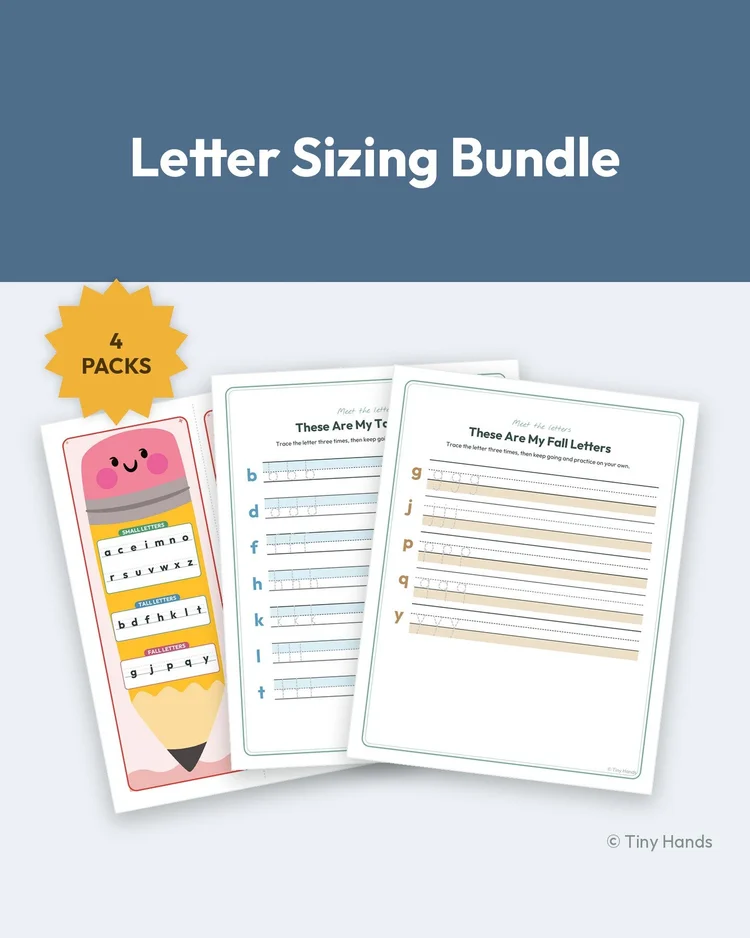
When writing looks messy, size is usually the piece doing the damage — and it’s the most fixable. The Letter Sizing Bundle gives tall, small and fall letter practice plus a pencil chart for the desk, so there’s one clear rule to aim at.
Shop the Letter Sizing BundleWhen is it time to ask for an evaluation?
Consider an OT evaluation, or ask your child's school team what they can offer, if:
- writing is painful, or the hand tires very quickly
- your child avoids writing or gets upset about it
- the gap between what they know and what they can get onto paper keeps widening
- you've worked on one target for about a month and see no change, or it's getting worse (you can ask sooner)
- their handwriting changes suddenly, or they seem to lose skills they had; if that comes with tremor, weakness or new clumsiness, call your child's doctor promptly
- they squint, tilt the head, cover an eye or skip lines, which is a reason for a full eye exam
- you also see difficulty with dressing, using utensils, or coordination
For a rough reference point, the CDC lists "writes some letters in her name" among the milestones that most children (75% or more) reach by age 5. That's an early letter-knowledge milestone, not a standard for how neat handwriting should look, and it isn't a cutoff. If you're worried about development, the CDC advises talking with your child's doctor and asking about developmental screening. Whether a child qualifies for school-based OT depends on the child, the school and how the difficulty affects participation in learning, so it isn't automatic.
New here? Grab the free pack first 🎁
Join the list and I'll send you the free 40-page Starter Pack: print-ready pages to build hand skills and handwriting confidence at home and at school.
Grab My Free Starter PackWant the whole library sorted and ready? Peek at the membership →
This article is for education only. It isn't a diagnosis or individualized advice. If you're concerned about a particular child, ask a licensed OT or your child's doctor.
Sources
- American Occupational Therapy Association, Evidence-informed intervention ideas: handwriting, children and youth 5–21 (accessed October 2026)
- Hoy, Egan & Feder (2011), A systematic review of interventions to improve handwriting, Canadian Journal of Occupational Therapy 78(1), 13–25
- Santangelo & Graham (2016), A comprehensive meta-analysis of handwriting instruction, Educational Psychology Review 28(2), 225–265
- Schwellnus et al. (2012), Effect of pencil grasp on the speed and legibility of handwriting in children, American Journal of Occupational Therapy 66(6), 718–726
- Schwellnus et al. (2013), Writing forces associated with four pencil grasp patterns in Grade 4 children, American Journal of Occupational Therapy 67(2), 218–227
- Brown & Link (2016), The association between measures of visual perception, visual-motor integration, and in-hand manipulation skills of school-age children and their manuscript handwriting speed, British Journal of Occupational Therapy 79(3), 163–171
- CDC, Milestones at 5 years and Learn the Signs. Act Early. (accessed October 2026)
Sources are summarized from abstracts and official pages. Findings are summarized in plain language and shouldn't be read as a promise for any one child.
This post is for learning and support — it isn't a diagnosis. © Tiny Hands