
Copying Shapes by Age: The Prewriting Skill That Comes Before Letters

You draw a simple circle and ask your kiddo to make one just like it. They give you a wobbly loop that doesn't quite close, or a scribble, or a flat "I can't." Meanwhile the preschool worksheet wants a square and a triangle, and you're quietly wondering if they're behind. Take a breath — this is one of the most predictable, easy-to-support skills there is, and knowing copying shapes by age takes all the guesswork out of it.
Here's the thing most people don't realize: shapes come before letters for a reason. Every letter is just a bundle of the same lines and curves kids first practice as shapes. A child who can copy a cross and a square already has the motor plan for a "t," an "L," an "E," an "H." So when we practice shapes, we're really pre-loading handwriting — no drilling letters required. Let me walk you through the order I actually watch for in sessions, plus the playful ways to build it at home.
Copying Shapes by Age: The Order I Watch For
Shapes show up in a beautifully predictable sequence — lines first, then curves, then corners, then diagonals (the hardest of all). This is the rough timeline I use, but please read it as a stage guide, not a deadline. Go by where your child is, not their birthday.
2–2½ years: lines first
A vertical line comes first (around 2), then a horizontal one (closer to 2½). This is also when kids "imitate" — they copy best right after they watch you draw it. If lines are still emerging, that's exactly on track. My pre-writing skills for preschoolers guide breaks down this earliest stage.
Lines3 years: the circle
Around age 3, that vertical-and-horizontal scribble rounds into a real, closing circle. It won't be perfect — a little egg-shaped or overshooting is completely normal — but the loop meets itself. This is the first true copied shape and a lovely milestone to celebrate.
Circle3½–4 years: the cross
Next is the plus sign — a vertical and a horizontal line crossing in the middle. It sounds simple, but it's a big deal: your kiddo now has to plan two strokes that meet at a point. Nail the cross and you're most of the way to letters like t, L, and E.
Cross4–4½ years: the square
Corners are the challenge here. A square asks a child to stop, change direction, and start a new line four times — that "stop and turn" is real motor planning. Early squares often have rounded corners or a runaway side, and that's fine. Clean corners come with practice.
Corners5 years: the triangle (and the X)
Diagonals are the last to develop, so the triangle and the X sit right around age 5. Slanted lines are genuinely harder for little hands to control, which is why they show up last — and why they're a classic kindergarten readiness checkpoint. If triangles are still tricky at 4, that's expected, not a worry.
DiagonalsNotice the pattern: straight lines, then curves, then corners, then diagonals. Letters follow the exact same difficulty ladder, which is why so many of the early ones (L, T, H, E, F) are all straight lines and crosses.
✏️ My go-to trick: "The Copy Ladder"
When a shape feels too hard, I don't drop it — I lower the rung. I think of copying as a three-step ladder, and we only move up when the step below feels easy. Rung 1 — Trace it: your child goes over a shape you've already drawn (dotted, or in highlighter). Rung 2 — Copy it: you draw the shape next to a blank space and they make their own beside yours. Rung 3 — Draw it: they make the shape from memory, with no model at all. Most frustration happens because we ask for Rung 3 when a kiddo is still comfy on Rung 1. Slide back down a step, get a few happy wins, then climb. It turns "I can't" into "look what I did" almost every time.

Playful Ways to Practice With Stuff You Already Have
Shape practice does not mean a stack of worksheets and a crying four-year-old. The best practice barely looks like practice at all. Here are the multisensory games I reach for most — nearly all use things already in your kitchen or junk drawer.
1. Draw it in a salt tray
Pour a thin layer of salt, sugar, or flour onto a dark baking sheet and let your kiddo draw shapes with a finger. The sensory feel makes it stick, and a quick shake erases every "mistake" — so there's zero pressure and endless do-overs. Shaving cream on the table works too.
Sensory2. Sky-write it big first
Before anything hits paper, draw the shape huge in the air together — "up, over, down, close!" Big arm movements teach the shape's path before we ask tiny fingers to do it. Sidewalk chalk and a wet paintbrush on the fence are perfect for this jumbo stage.
Gross motor3. Build it before you draw it
Make shapes out of play dough snakes, popsicle sticks, or dry spaghetti. Building a square from four sticks helps a child feel that it has corners and equal sides — understanding the shape makes drawing it so much easier. Great fine motor, too.
Hands-on4. Go on a shape hunt
"Find me a circle!" Clocks, plates, windows, road signs — spotting shapes in the real world builds the visual side of the skill (a child has to see a shape clearly before they can copy it). A no-materials game for the car or a walk.
Visual5. Draw on the window
Washable markers on a window or glass door turn shape practice into a novelty. Drawing on a vertical surface also builds the wrist and shoulder strength that handwriting leans on. Let them trace a shape you've taped up on the other side of the glass.
NoveltyIf you want even more no-prep hand-strength ideas that feed right into shape drawing, my roundup of fine motor activities using things you already have is full of clothespin, tong, and sticker games.
Heads up: this post has an Amazon affiliate link. If you grab something through it, Tiny Hands earns a small commission at no extra cost to you — it's what keeps the free worksheets free. Thank you!
Two shape helpers I love — for seeing them, then drawing them
You can build every bit of this with a finger and a salt tray — but if you want a grab-it-off-the-shelf option, these two make a lovely pair. A chunky wooden shapes puzzle lets little ones see and hold each shape first (that's where copying starts), and a grooved magic copybook guides the pen along the right path so tracing shapes and letters finally clicks — with fading ink so it lasts and lasts.
When to Check In With an OT
First, the reassuring part: an "imperfect" shape is almost always a perfect shape for that age. Wobbly circles, rounded-off squares, triangles that look more like blobs — all completely normal while the skill is still cooking. And a child who copies best right after watching you is showing exactly the imitation stage we'd expect, not a delay.
That said, a quick, no-pressure chat with a pediatric OT or your child's provider can be reassuring if, past age four or five, you're consistently seeing things like a child who can't yet copy a circle or a cross no matter how you break it down, who avoids drawing and coloring altogether and gets upset when asked, whose shapes look far simpler than same-age friends' across several months, or who has real trouble planning the strokes — starting in random spots, unable to "stop and turn" for corners even with tracing help.
None of those is an emergency — they're just gentle "let's take a closer look" flags, and there's almost always a simple, playful tweak that helps. Once shapes are solid, letters are the natural next step, and my guide on teaching your child to write their name picks up right where this leaves off. You've got this.
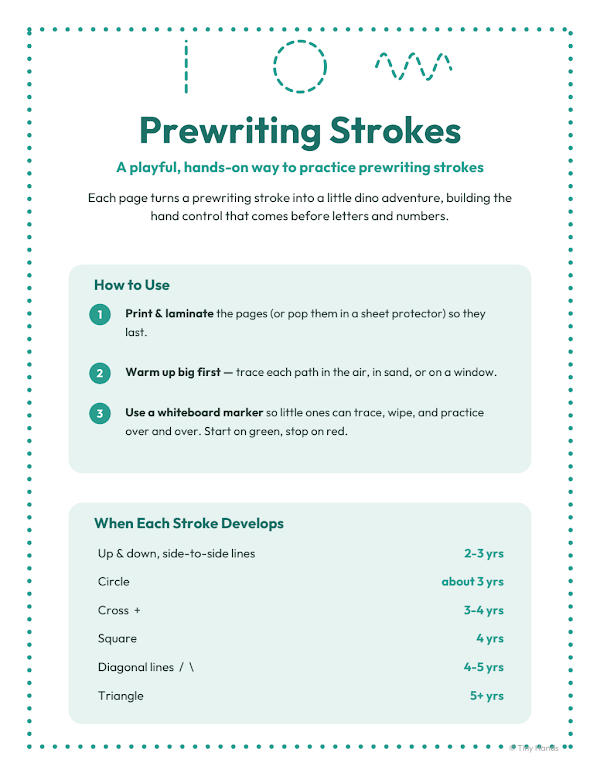
Want the print-and-play version?
My Shape Tracing Pages live in the membership — dotted shapes to trace, copy-beside-the-model boxes, and draw-it-from-memory pages that walk kids right up the Copy Ladder, with a picture prompt on every page. Hand your kiddo a page and let it run itself. Ready in about two minutes.
Get the Shape Tracing PagesNew here? Grab the free pack first 🎁
Join the list and I'll send you the Fine Motor Starter Pack — 40+ print-ready pages to build those little hands at home, from first scribbles to strong, steady shape-makers.
Send My Free PackWant the whole library, sorted and ready? Peek at the membership →
This post is for learning and support — it isn't a diagnosis. © Tiny Hands