
✏️ Handwriting
Spacing Between Words in Handwriting: The Trick That Finally Gives Kids Room

If your kid's sentences look like one long smooshed-together word — thatsmylunchbox instead of that's my lunch box — you're not doing anything wrong, and neither are they. Spacing between words in handwriting is its own separate skill, and it usually lags behind letter formation by months, sometimes longer.
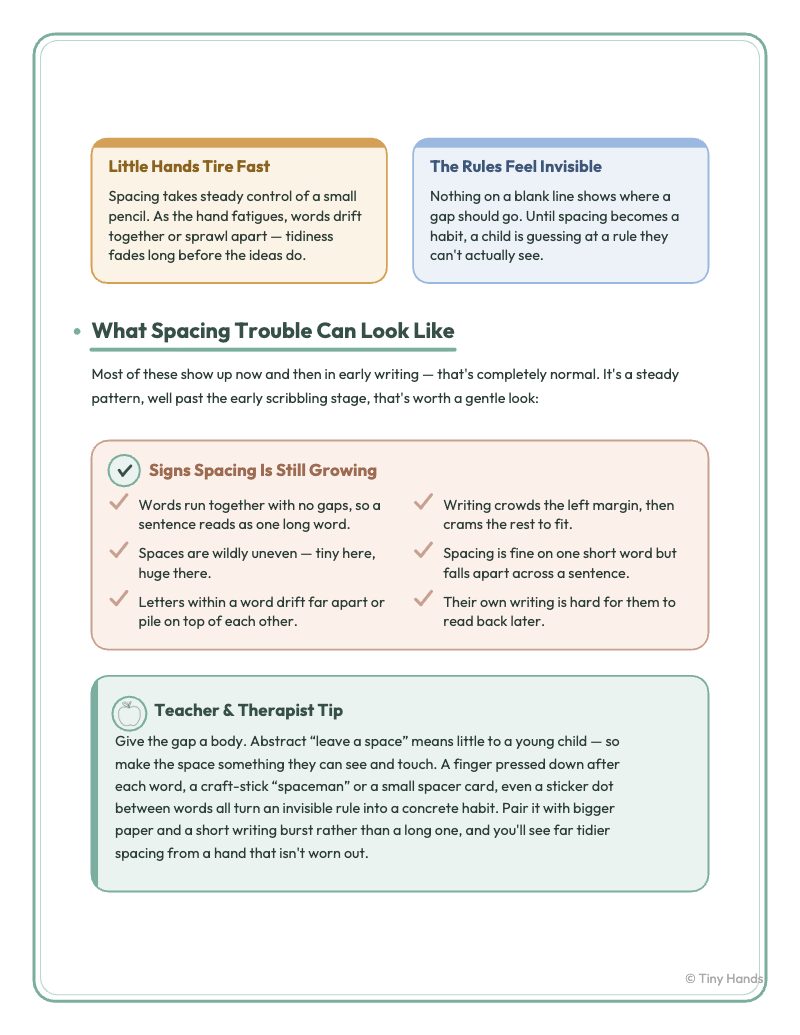
Here's why: leaving a space asks a kid to do something invisible — stop, hold a gap open in their head, and start again — with zero visual landmark to guide them. Letters have a shape to copy. A space doesn't. Most kids don't reliably space their words until somewhere between kindergarten and first grade, and it clicks fastest with a physical placeholder, not a reminder to "leave a space."
My go-to fix is what I call the Pop-and-Space Trick: after every word, your kid pops down a tiny spacer — a finger, a popsicle stick, anything about the width of a fingertip — and starts the next word right after it. It turns an invisible rule into something they can actually see and touch. Below is the timeline I use in sessions, the trick in full, and easy ways to practice with stuff you already have.
📏 When Do Kids Actually Start Spacing Their Words?
This is a real developmental order, not a "some kids just get it" thing — here's the by-age timeline I use in sessions:
If your kindergartner's words are still bumping into each other, that's not a red flag — that's the timeline working exactly as expected. What actually moves a kid along faster than time alone is giving them something concrete to place between words, which is exactly what the trick below does.
🧩 What's the Trick to Teaching Word Spacing?
The Pop-and-Space Trick works because it replaces an abstract rule ("leave a space") with a concrete object your kid can physically place. After writing a word, they pop a spacer down on the line, then start the next word touching it. No spacer, no next word — it becomes a habit fast because the rule polices itself.
In session, I reach for these little finger spacers — they're sized just right for little hands, and kids genuinely like "popping" them into place. You can also use a fingertip, a coffee stirrer snapped in half, or a single LEGO brick — the tool matters less than the habit of pausing to place something down.
This post contains an affiliate link. As an Amazon Associate I earn from qualifying purchases, at no extra cost to you.
🎨 What Are Easy Ways to Practice Word Spacing at Home?
You don't need a worksheet to build this — a few minutes of playful practice does more than nagging ever will:
The LEGO Fence
Write a sentence on a whiteboard and have your kid set a small LEGO brick between each word before starting the next one — pull the bricks off when they're done to "reveal" the finished sentence.
Caterpillar Words
Draw a little caterpillar segment (just a circle) between each word as they write — it turns spacing into a doodle game instead of a rule.
Sidewalk Chalk Sentences
Write giant sentences outside and make the "space" a full sideways step — big-body practice makes the concept click before it's ever small on paper. More ideas in our sidewalk chalk activities post.
Snack Spacer
Use a cracker or a small candy as the placeholder between words — pop it down, write the next word, eat it when the sentence is done. (Motivating, and self-limiting on the sugar front.)
If handwriting still feels tiring by the time spacing comes up, it's worth checking that the fundamentals are solid first — our posts on pencil pressure and handwriting warm-ups are a good next stop. And if spacing is solid but the letters themselves still drift in size, letter sizing in handwriting and handwriting on the lines tackle the two skills that usually come up right alongside it.
🩺 When Should I Check In With an OT About Spacing or Handwriting?
Uneven spacing on its own almost never means anything is wrong — it's one of the last handwriting skills to lock in, right along with consistent letter size. I'd take a closer look if, by second grade, a child still can't tell you where one word ends and the next begins even when you point it out, if letters themselves are still a real struggle, or if writing is so effortful that it's getting in the way of getting ideas on the page. Spacing that used to be fine and suddenly falls apart is also worth a second look — sometimes that's fatigue, and sometimes it's a sign the whole handwriting system (grip, pressure, letter formation) needs a tune-up before spacing can catch up. Otherwise? Keep popping the spacer down and give it time — this is one of those skills that mostly just needs more reps, not more worry.
Keep Reading
This post is for learning and support — it isn't a diagnosis.
© Tiny Hands