


Do Slant Boards Help Handwriting? What the Research Does and Doesn't Say

A slant board is a tilted writing surface, often sold at around 20 degrees (many adjust), that props the paper up instead of leaving it flat on the desk. The honest answer to "do slant boards help handwriting?" is that I couldn't find good evidence that they improve how legible a child's writing is. They may make some children more comfortable, and that is reason enough to try one, as long as you judge it by what you see in your child and not by what the product page promises.
The one randomized comparison I could find was small and found no difference between slant board and flat-desk practice. The strongest evidence I found supports teaching and practicing handwriting itself, and I found no good research showing that the writing surface changes outcomes. So a slant board is a low-cost experiment, not a handwriting fix.
What is a slant board supposed to do?
The usual claims are that the tilt puts the wrist in a more extended position, brings the page closer to the child's line of sight so the neck and shoulders don't fold over the desk, and makes it easier to see what's being written. Some therapists use a binder, a clipboard on a stack of books, or an easel as stand-ins.
Those ideas make physical sense, and in my experience some children do look more comfortable with a tilted page, though that's an impression, not evidence. But "looks more comfortable" and "writes more legibly" are different outcomes, and I couldn't verify the second. Many of the pages I found about slant boards list wrist, grasp and posture benefits without pointing to studies, so I've left those claims out here.
What does the research actually show?
There's very little, and what exists is small. Here is what I found, with its limits:
- Slant board vs. flat surface, school-age children. An occupational therapy dissertation (Brevoort, Nova Southeastern University, not peer-reviewed) randomly assigned 21 children entering grades 2 and 3 to practice handwriting on a slant board or a flat surface for fifteen 15-minute sessions over four weeks, using the same handwriting curriculum in both groups. The children came from a summer enrichment program and weren't chosen for handwriting difficulty. The two groups did not differ significantly in average change in letter formation. In a secondary analysis, children who started with below-average handwriting improved regardless of surface, which is suggestive only. This is one small study, so treat it as a hint, not a verdict. Evidence strength: very limited.
- Vertical surface, preschoolers. A study in the American Journal of Occupational Therapy (Portnoy and colleagues, 2018) had 22 typically developing preschoolers and 13 with mild disabilities copy and trace shapes on a drawing tablet, once seated at a desk and once standing with the tablet vertical in front of a wall. Children moved faster and more smoothly on the vertical surface, with no loss of accuracy. The children with mild disabilities used their upper trapezius (a shoulder and neck muscle) more during short vertical tasks; the authors read that as possible proximal muscle control, but it's their interpretation. This was a short lab session, with shapes on a tablet rather than handwriting on paper, and a fully vertical surface rather than a slant board. It tells us about speed, smoothness and muscle activity in one session, not whether handwriting improves over time. Evidence strength: limited.
- What does have support: handwriting instruction. A 2016 meta-analysis of handwriting instruction (Santangelo and Graham) found that teaching handwriting improved legibility and fluency, while motor instruction (fine-motor work without handwriting) did not improve handwriting. It compared instruction with other conditions, not writing surfaces. The American Occupational Therapy Association's handwriting evidence summary (ages 5–21) describes strong support for therapeutic, guided handwriting practice and no evidence for isolated activities aimed at underlying components. "No evidence" means studies haven't shown a benefit, not that those activities do harm. The AOTA page I could read says nothing about slant boards either way, and parts of it are behind a membership wall.
The angle people quote also deserves a caveat. A children's OT service in Wales publishes a "Write Angle" sheet describing a 20-degree slope, framed around posture and comfort. It cites no research, so I'd treat 20 degrees as common practice rather than something tested.
What else could be behind the struggle?
Before buying anything, it helps to ask what the board is meant to fix. If the hand tires, if letters are formed in odd ways, or if the writing is messy, the cause may not be the flat desk at all. Possibilities an OT weighs include:
- Not knowing the letter forms well, so the pencil wanders even when the hand is fine. A tilted page won't teach where to start an "a."
- Visual-motor demands, such as copying from a model. Our post on visual motor integration covers this one.
- Desk and chair fit. Feet dangling, a desk too high, or a slumped trunk can make writing tiring no matter what the page is doing. See classroom seating accommodations and core strength for handwriting.
- Grip and pressure. Pressing hard or gripping tight can make a hand ache. Our post on why a child's hand hurts when writing goes through these.
- Task demand. Long copying tasks, speed expectations and fatigue can wear down legibility in any child.
- Vision or paper position. Left-handed writers in particular may need a different paper angle, which we cover in left-handed kids: scissors and writing. A child who squints, tilts their head or loses their place may need an eye exam.
A slant board is most likely to be worth a trial when posture, comfort or line of sight seem to be part of the picture: a child who hunches, rests their head near the page, or seems uncomfortable (if there's actual pain, read the evaluation list below first). In my clinical reasoning, which hasn't been tested, it's less likely to help when the main issue is letter knowledge or spacing. For that, see messy handwriting in kids.

How do I try a slant board fairly?
If you want to experiment, here's a way to do it that tells you something:
- Decide what you're watching for first. Pick one or two things: complaints of hand or neck tiredness, how long your child writes before wanting a break, or posture. Jot down how it looks on the flat desk for a few days so you have something to compare against.
- Keep everything else the same. Use the same task and the same pencil for two to three weeks, ideally alternating board days and flat days, and ask a teacher or another adult what they notice about tiredness. Changing the surface and the practice routine at once makes it impossible to know what helped. (That window is my rule of thumb, not a researched number.)
- Make it stable. A board that slides, or a pencil that rolls down the slope, will frustrate any child. A non-slip mat under the board and a pencil groove or lip at the bottom help. A large three-ring binder works as a free trial version; keep the ring spine away from your child. If the desk is already high, a slope can push the shoulders up, so check desk height too.
- Check the fit. The board shouldn't make the desk feel too high, and the child's forearm should rest comfortably on it. Some children find a tilted page awkward at first.
- Let your child's report count. If they say it feels better, or worse, that's useful information. If it helps comfort but not letter shapes, that's a fine result. It just means letter shapes need their own attention.
If it doesn't seem to help
That's useful too. Put the board away and look elsewhere on the list above. Vertical work, like writing on a wall-mounted whiteboard or an easel, is another low-cost option. The preschool study found children drew shapes faster and more smoothly on a vertical surface, though we don't know whether that carries over to handwriting. Keep vertical tasks short, with the work around shoulder-to-eye height, and stop if the shoulders hike up or your child tires.
Common mistakes
The most common one I see is buying a board and expecting it to do the work of practice. The other is leaving it in place for months without ever asking whether it's helping. A third is using it to try to force a "correct" wrist position on a child who has found a comfortable way to write. Comfort and function matter more than matching a picture.
From the Tiny Hands shop
The Other Half of the Setup Is the Paper
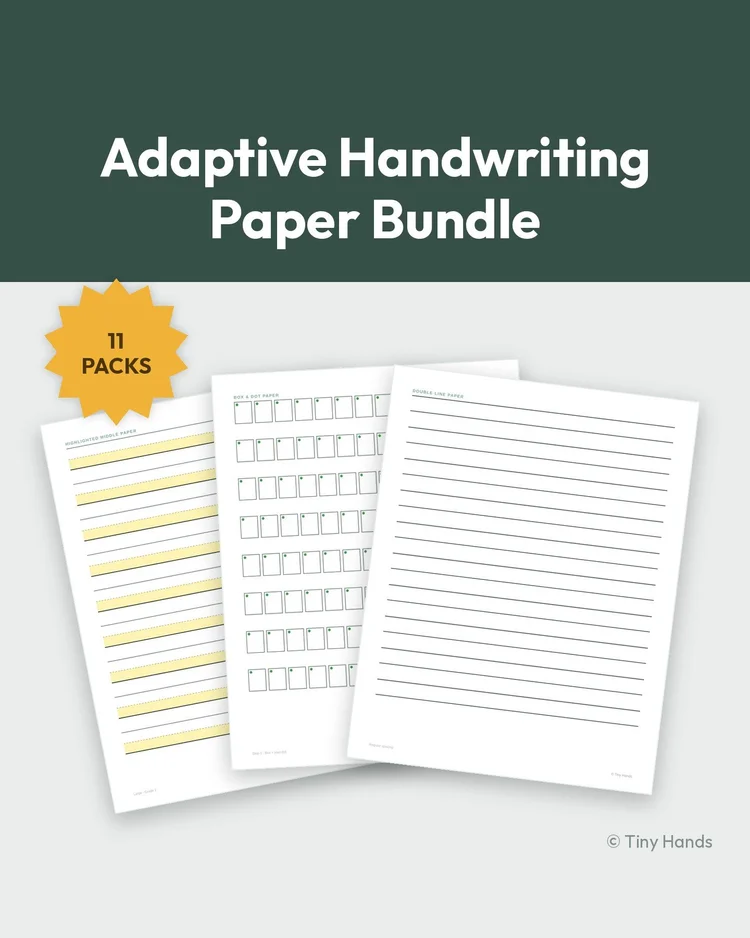
A slant board changes the angle; the paper changes what they aim for. The Adaptive Handwriting Paper Bundle has the raised-feel, highlighted and boxed line styles I reach for most, so you can test which one actually tidies their writing.
Shop the Adaptive Paper BundleWhen should I ask for an evaluation?
A tilted board is not a substitute for assessment. Consider talking with your child's doctor, an OT, or the school team if:
- writing is painful, or the hand cramps or tires very quickly
- posture problems or complaints of neck or shoulder pain come with writing
- your child avoids writing or gets upset about it, or the picture isn't improving after a few weeks of focused practice
- you see tremor, weakness, a lost skill or new clumsiness (call the doctor promptly)
- difficulty also shows up in dressing, utensils or coordination
An OT can watch your child write, look at how the desk, chair and task fit, and tell you whether a slant board is likely to be worth the money. Whether a child receives school-based OT depends on the child, the school and how the difficulty affects participation, so it isn't automatic. We walk through what to ask for in school OT for handwriting.
New here? Grab the free pack first 🎁
Join the list and I'll send you the free 40-page Starter Pack: print-ready pages to build hand skills and handwriting confidence at home and at school.
Grab My Free Starter PackWant the whole library sorted and ready? Peek at the membership →
This article is for education only. It isn't a diagnosis or individualized advice. If you're concerned about a particular child, ask a licensed OT or your child's doctor.
Sources
- Brevoort, K., Effect of slant boards in combination with handwriting practice, Nova Southeastern University OT student dissertation (abstract; dissertation, not peer-reviewed)
- Portnoy et al. (2018), Graphical product quality and muscle activity in children with mild disabilities drawing on a horizontally or vertically oriented tablet, American Journal of Occupational Therapy 72(6), 821–828, doi:10.5014/ajot.2018.027532 (abstract)
- Santangelo & Graham (2016), A comprehensive meta-analysis of handwriting instruction, Educational Psychology Review 28(2) (summary page)
- American Occupational Therapy Association, Evidence-informed intervention ideas: handwriting for children and youth 5–21 (accessed October 2026)
- Aneurin Bevan University Health Board Children's OT, Write Angle: writing slope (practice guidance, no research cited)
Sources are summarized from abstracts, summary pages and official pages, not full texts. Findings are described in plain language and shouldn't be read as a promise for any one child.
This post is for learning and support — it isn't a diagnosis. © Tiny Hands