
Sensory-Friendly Classroom Ideas: Small Changes, Calmer Kids

It's 10am, the fluorescent lights are buzzing, twenty-five kids are talking at once, and one little guy has half-crawled under his table with his hands over his ears. You're not doing anything wrong — that's just what an ordinary classroom sounds and feels like to a nervous system that's already maxed out.
Here's the short version: the sensory friendly classroom ideas that actually work are five small tweaks, in five specific zones — sound, light, seating, touch, and transitions — and almost all of them are free or under $30. Do a "hum test" and kill the noise you stopped hearing months ago. Turn off half the fluorescent bank and add one warm lamp. Give the wiggly bodies a legal place to move instead of asking them to stop. Offer a texture opt-out instead of insisting kids push through. And warn the room twice before every single transition, the same way, every time. You don't need a grant, a sensory gym, or a special ed degree — and every one of these helps the whole room, not just your one sensory-sensitive kiddo.
So take a breath. Below is the room-by-room checklist I run first as an OT, my go-to trick for catching trouble before it's a meltdown, and the short list of tools genuinely worth keeping in a drawer.
What Does "Sensory-Friendly" Actually Mean?
It doesn't mean a special room, a weighted-vest budget, or singling anyone out. A sensory-friendly classroom is just one where the lights, sound, seating, and transitions have been nudged down a notch so more nervous systems can settle into learning — and here's the part that surprises people: every single fix below helps the whole room. Nobody has to know why the lights got dimmer. They just know the room feels easier to be in.
What Are the 5 Sensory-Friendly Classroom Ideas That Cost Almost Nothing?
I check these five zones first, in this order, whenever a room feels harder than it should.
Heads up: this post has Amazon affiliate links. If you grab something through one, Tiny Hands earns a small commission at no extra cost to you — it's what keeps the free worksheets free. Thank you!
Sound: run the "hum test"
Stand still and just listen — buzzing lights, scraping chairs, an echo off the hard floor. Tennis balls or felt pads on chair and table legs cut a shocking amount of noise, and swapping "quiet down!" for a hand-up or light-flick signal means you're not adding more sound to a room that's already loud. For the kid who still can't filter it, a pair of kids' noise-reducing ear muffs in a basket by the door is the single highest-value thing in my bag.
Tennis balls + a silent signalLight: kill the flicker
Fluorescents buzz and flicker in a way plenty of kids (and teachers) can feel even if they can't name it. Turn off half the bank, add one warm lamp in a corner, and let window light do the rest when you can. If you can't control the switches — and in a lot of buildings you genuinely can't — magnetic light covers snap straight over the panels and soften the whole room without asking facilities for anything. A visor or sunglasses at a desk is a tool, not a "no."
One lamp beats six fluorescentsSeating & movement: build in the wiggle
Sitting still for long stretches is genuinely hard for a lot of developing bodies — not defiance, just biology. A wobble cushion lets a kid move without leaving the chair, and stretchy bands across the chair legs give busy feet something to push against all day. Both do more for focus than any amount of "sit still, please." I go deep on the why in core strength for handwriting and how to help a child sit still in class.
Movement earns focusTouch & texture: offer, don't force
Carpet time can be scratchy, glue can feel awful, paint can feel worse. Keep a small towel or mat for carpet-texture kids, wipes within reach, and a spoon or glove option instead of insisting on bare fingers. For the kiddo who settles best under a little weight, a 2 lb weighted lap pad at the desk is quiet, portable, and nobody else even notices it. Nobody has to "get used to it" today.
A towel solves more than you'd thinkTransitions: warn before you switch
This is the single biggest trigger in most rooms. A 5-minute warning, a 1-minute warning, and the same transition song every time teach the room's nervous system what's coming. A visual countdown timer does the warning for you — kids can see the time shrinking instead of having to trust it — and a visual schedule board on the wall means "what's next?" gets answered before it's asked.
Same song, every timeIf you only buy three things, buy these
Teachers ask me this constantly, so here's the honest answer. Ear muffs for the kid who can't filter the room, a set of wobble cushions so the wiggly bodies have somewhere legal to put it, and a visual timer so every transition comes with a warning you don't have to remember to give. Under $60 for all three, and they cover the three loudest problems in almost every room I walk into.
🧩 My go-to trick: "Dim It, Don't Flip It"
The single most useful habit I teach teachers costs nothing and takes about three seconds. The moment you notice the room's energy climbing — voices creeping up, chairs scraping faster, one kid starting to fidget harder — make one small adjustment right then: drop your own voice to almost a whisper, flick a light off, or cue a 30-second stretch. Don't wait for the room to fully flip into a meltdown before you react; dim it early and often, and you'll rarely need the big reset. And if a kiddo's already past dimming and needs a full reset spot to land in, that's exactly what a calm-down corner is for — set one up before you need it, not during.
When you can't control the light switch
This is the fix I wish more teachers knew about. In most buildings the fluorescent bank is all-or-nothing, so "turn off half the lights" simply isn't available to you. Magnetic light covers snap right onto the panels — no ladder-and-facilities-request situation — and they take the harsh flicker down to something soft and daylight-ish. Around ten dollars for a pair, and it's the single change teachers write back to me about most.

Which Sensory Tools Are Actually Worth Keeping in a Drawer?
None of this needs a catalog order. Here's what earns its shelf space in my rooms.
A quiet sensory bin
Rice, dry beans, or pom-poms in a shoebox tucked in a low-traffic corner. No production, no announcement — hands go in, a kid resets, nobody has to leave the room. If you want it to survive the year, lidded clear bins stack and stay clean far better than a shoebox does.
Shoebox + rice = freeA fidget basket by the door
Grab one on the way to the rug, drop it back on the way out. Keeping it at a transition point (not a desk) means it gets used as a tool, not a toy that never comes back. My two picks that stay quiet and don't become flying objects: textured worry stones and finger maze boards. More options in my classroom fidget tools guide.
At the doorway, not the deskSomething to breathe with
"Take a deep breath" is an abstract instruction for a five-year-old. An expanding breathing ball makes it visible — the ball opens, you inhale; the ball closes, you exhale. It works on a whole circle at once and it's the one calm-corner tool kids ask for by name.
Show the breath, don't say it"Name it to tame it" bottles
Watching glitter or beads settle while naming the feeling out loud is a two-minute reset that works for the whole class, not just one kiddo. I keep a set of calm-down sensory bottles in my therapy bag for exactly this — more on those below.
Watch, breathe, name itA personal-space spot for every kid
At rug time, one marked square of floor per kid. It sounds silly and it works — fewer bumped elbows, fewer "they touched me" moments, calmer whole-group time. A roll of painter's tape does it for free; numbered carpet spot markers do it without re-taping every September.
One spot each, endless peaceA landing spot for the chewers
Shirt collars, pencil erasers, sleeve cuffs. Chewing is a regulation strategy, not a habit to break — so redirect it rather than stopping it. A silicone chew necklace gives that input a sanctioned home and saves you the laundry conversation.
Redirect, don't forbidWatch-and-breathe bottles for big feelings
Each bottle matches an emotion — a mesmerizing, screen-free way for a kiddo (or a whole circle-time group) to slow down and name what's going on inside without any big production. I keep a set of these calm-down sensory bottles right next to the calm-down corner supplies, and they get grabbed constantly.
When Does One Kid Need More Than the Room-Level Fixes?
Here's the honest, non-alarmist truth: the five zones above solve most of it, for most kids, most of the time. Please don't read a wiggly, noise-sensitive, or texture-picky kiddo as a problem to solve — sensory needs exist on a totally normal spectrum, and plenty of kids just need the room turned down a notch, same as you might reach for sunglasses on a bright day.
That said, it's worth a friendly, no-pressure chat with an occupational therapist if — even after the room-level changes are in place — you're still consistently seeing one particular kiddo who covers their ears or eyes at ordinary classroom noise and light, melts down at nearly every transition despite the warnings, avoids or seeks touch so intensely it's disrupting friendships or learning, or needs so much movement that regular breaks never seem to be enough. None of that means something's wrong — it just means that one kiddo's nervous system might want an individualized plan on top of the room-wide fixes, and an OT can help you build one.
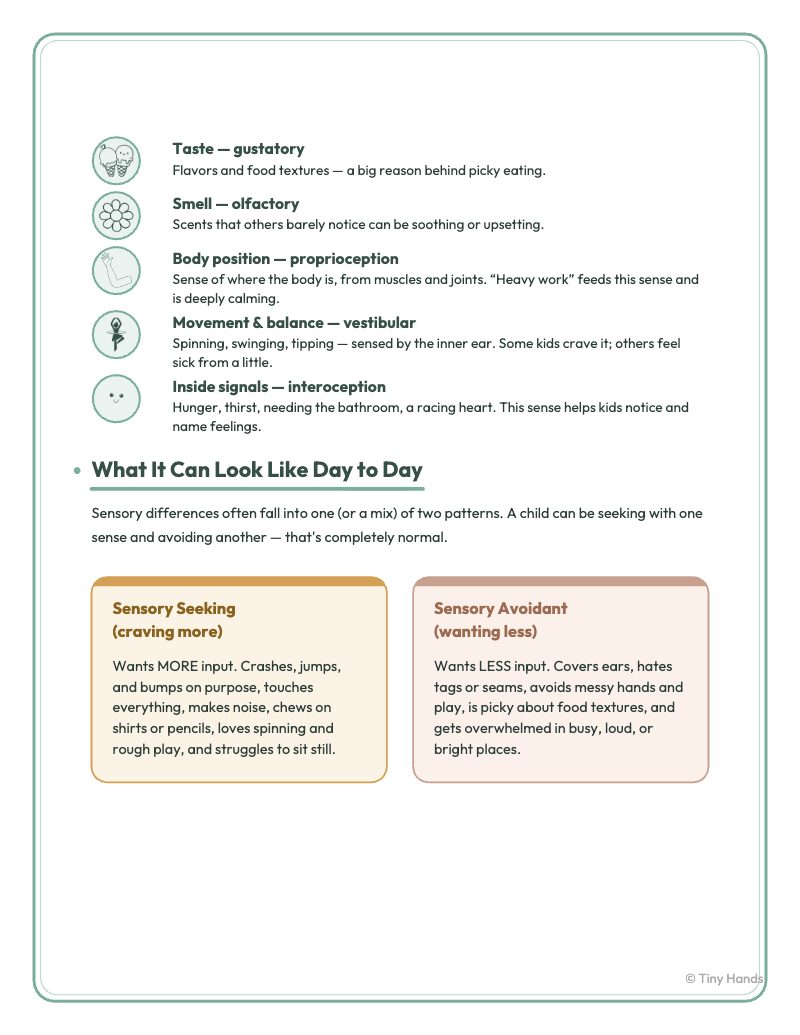
Want the Printable Version?
It's ready to print, right in the membership.
See What Is Sensory ProcessingNew here? Grab the free pack first 🎁
Join the list and I'll send you the Fine Motor Starter Pack — 40+ print-ready pages to build focus, strong little hands, and calm-down skills at home or in the classroom.
Send My Free PackWant the whole library — sorted and ready?Peek at the membership →
This post is for learning and support — it isn't a diagnosis. © Tiny Hands