


Does the Zones of Regulation Work? What the Research Says and How to Use It Well

Does the Zones of Regulation work? It depends on what you mean by "work." Teachers in one small study reported that students picked up the emotional vocabulary, but that is teacher opinion, not objective measurement. What the research does not yet show is that the program, on its own, helps children actually regulate better or behave differently. A 2024 review in The Journal of Special Education concluded the program cannot be categorized as an evidence-based practice at this time, mainly because there are so few good studies (only 3 of the 37 studies the authors found met their inclusion criteria, according to a summary of the review). The developer describes the evidence for its digital curriculum as preliminary and promising, and says larger trials are still underway.
That is not the same as "it doesn't work," and it isn't a reason to throw out a tool your school or therapist already uses. It is a reason to use it for what it can reasonably do, and to put the real weight on things we have better reason to trust. This post covers what the Zones are, what the studies found, where I think the approach helps or backfires, and how to use it well at home or in a classroom.
What is the Zones of Regulation?
It is a social-emotional learning framework created by Leah Kuypers, an occupational therapist who worked in public schools. It sorts feelings, alertness and energy levels into four colors: blue, green, yellow and red. Children learn to notice which zone they are in and to try tools and strategies that might help. The program materials also describe co-regulation strategies for the adults around the child. It is used in schools, therapy clinics and homes, and the developer describes it as for learners of all ages, and the studies I read involved elementary and middle school students, including autistic learners aged 6 to 13.
What does the research actually show?
I read the studies and reviews I could access. Several were web summaries and abstracts rather than full journal texts, so I'm describing them in broad strokes.
The independent review
Mason, Leaf and Gerhardt (2024) reviewed the research on the program and found very little empirical evidence of effectiveness. They concluded it does not meet the standards used to label a practice evidence-based and called for more research. This is a review of the research, not a trial of the program itself, and I read only its abstract.
Limited evidenceOne small randomized trial
Ochocki and colleagues (2020) randomly assigned 63 elementary students who had been flagged for disruptive behavior. School social workers taught 12 Zones lessons over six weeks. The researchers found no statistically significant decrease in disruptive behavior and no improvement in self-control. Small sample, short program, one kind of student: it doesn't settle the question, but it is the kind of result that tempers big claims.
Not significantThe developer's own summary
The developer's evidence brief describes a 2024 pilot of the digital curriculum in five elementary schools (three intervention, two comparison) using social-emotional ratings, and calls the evidence "preliminary, promising." It also lists small feasibility and quasi-experimental studies, and says larger randomized trials are still in progress. Because that summary is written by the program's own team, I treat it as a lead to watch, not as proof.
Promising, not provenWhat teachers say
A qualitative study from Aspect in Australia (14 teachers in five Aspect schools, which serve autistic students) found teachers saw growth in students' emotional language and social awareness. They also said the program needed significant adapting for students with intellectual disability or who use AAC (augmented and alternative communication). This is teacher opinion only, not peer-reviewed, with no objective measures and a small group.
Opinion, small samplePutting it together: teachers and the developer report gains in emotional language and social-emotional ratings, but neither source is independent or objective, and there is no clear evidence yet that the program itself changes how well children regulate or behave. The Ochocki trial measured disruptive behavior and self-control, which may not be what the curriculum mainly targets, so a null result there is not the final word either.
Does social-emotional teaching at school help at all?
Social-emotional learning in general has better support than this one program. A large meta-analysis of school-based social and emotional learning programs (Durlak and colleagues, 2011; 213 studies and about 270,000 students) found that students in these programs did better than comparison students on social-emotional skills, attitudes, positive behavior and academics, with fewer conduct problems and less emotional distress. Effects were smaller at follow-up but still present, school staff delivered the programs successfully, and results depended on how well they were run (step-by-step, active teaching of specific skills). Many of the studies were older and mostly from the U.S. The review covers many programs, not the Zones specifically, so it supports the general idea rather than this brand.

Why can a child know their zone and still melt down?
Because knowing and doing are separate skills, and the second depends on much more than a poster. When I'm trying to work out why a child isn't using a strategy they clearly know, I look at a few things:
- Where they are when it's needed. In my experience, a child in the middle of an intense moment often can't pull up a strategy they know. Strategies are usually taught when calm and used with an adult's help at first.
- What the demand is. A task that's too hard, too long or too loud will produce big feelings no matter what chart is on the wall.
- Basic state. Hunger, poor sleep, illness, and fatigue after a long day (see after-school meltdowns) all make regulation harder.
- Communication. A child with limited speech or language may not be able to say "I'm yellow," even if they feel it.
- Sensory, attention and other factors. These can matter for some children, but they are not the automatic explanation, and the evidence for many sensory tools is limited or mixed. If you are weighing fidgets specifically, classroom fidget tools covers options.
Teaching the colors harder usually won't address those. Changing the demand, the setting or the support is more likely to.
How can the Zones backfire?
This section is my clinical opinion, not a research finding. These are patterns I'd watch for.
- Colors turning into grades. If green means "good" and red means "bad," children can learn to hide feelings or feel ashamed of them. Every feeling is okay to have, and a display that quietly says otherwise works against that. Public displays that move a child's name or clip up and down the colors deserve the same caution I gave in clip chart anxiety in kids.
- Expecting children to stay in green. Feeling sad, angry or excited are normal parts of life. The goal is helping a child cope with a feeling and still take part, not to make it go away.
- Putting the work only on the child. A child can be taught every strategy and still need an adult to stay calm, lower the demand and help. A U.S. practice brief on co-regulation (Rosanbalm & Murray, 2017, a synthesis of the literature rather than a new study) describes a warm, responsive relationship, a safe and predictable environment, and teaching and coaching self-regulation skills, with children taking on more over time.
- One strategy list for everyone. What helps one child (movement) may annoy another. The Aspect teachers' comment that it needs to be differentiated fits what I see.
- Using it for the wrong problem. If a child's big reactions come mainly from anxiety, trauma or unmet communication needs, a color chart alone is unlikely to be enough. The Zones is not a treatment for anxiety, ADHD or sensory differences.
A simple way to use it well
Use the colors as a shared language, not a scoreboard. Teach one or two feelings at a time when everyone is calm. Let the child pick what goes on their own list of strategies, and test each one over a few weeks to see whether it actually helps (some days it won't). When a hard moment comes, the adult's job comes first: stay calm, use fewer words, lower the demand, and talk it through afterwards.
How to adapt it for different children
- Younger or earlier-developing children: start with just two or three feelings and use real photos or the child's own drawings. Skip the abstract chart.
- Children with limited speech or a need for more support: pair every zone with a picture, a gesture or an AAC button, and let the child point. Check understanding by watching what they do, not by asking them to explain.
- Children who avoid or shut down: offer a private check-in (a card on the desk, a quiet signal) instead of a public one.
- At home: keep it playful and low-key. Name your own zone out loud ("I'm feeling a little yellow, so I'm taking a minute"). Kids learn a lot from watching how you cope. For more ideas, try emotional regulation activities for kids, a calm-down corner, or a feelings chart.
Picture a second grader (a made-up example) whose name moves to "red" a few times a week at school. Before adding a stronger strategy, I would want to know what happens in the minutes before: Is it a certain subject, the noisy transition, the skipped snack? Often that answer changes the plan more than any chart.
From the Tiny Hands shop
Name the Feeling Before You Pick the Colour
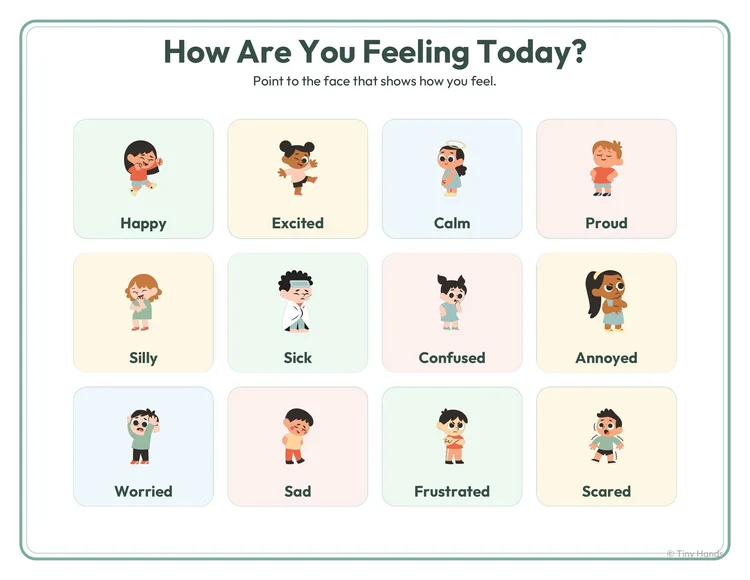
A zones chart only works if a child can tell you what they are actually feeling. The Feelings Identification Pack builds that vocabulary with pages kids enjoy doing, so the colours have something real underneath them.
Shop the Feelings Identification PackWhen should I ask for more support?
A classroom program or a home routine may not be enough if big reactions are frequent and intense, last a long time, put anyone's safety at risk, or are getting in the way of friendships, learning or daily routines. Mention it too if a child has recently changed (new fears, stomachaches, refusing school), and raise any loss of skills they had already gained with the pediatrician promptly. If a child is hurting themselves or others, or a situation feels unsafe right now, contact the pediatrician or local emergency or crisis services right away. A good first step is the pediatrician and the school team, who can look at hearing, sleep, learning, language, anxiety and other possible contributors. An OT evaluation can look at how sensory, motor and daily-routine factors fit in. A mental health professional can help when anxiety, mood or trauma may be involved. In the U.S., what a school can offer depends on the child's needs and the school's process, so ask the school what the process is. Rules in other countries differ.
New here? Grab the free pack first 🎁
Join the list and I'll send you the free 40-page Starter Pack: print-ready pages to build hand skills and handwriting confidence at home and at school.
Grab My Free Starter PackWant the whole library sorted and ready? Peek at the membership →
This article is for education only. It isn't a diagnosis or individualized advice. If you're concerned about a particular child, ask a licensed OT or your child's doctor.
Sources
- Mason, B. K., Leaf, J. B., & Gerhardt, P. F. (2024), A research review of the Zones of Regulation program, The Journal of Special Education 57(4), 219–229 (abstract read)
- Ochocki, S., Frey, A. J., Patterson, D. A., Herron, F., Beck, N., & Dupper, D. R. (2020), Evaluating the Zones of Regulation intervention to improve the self-control of elementary students, International Journal of School Social Work 5(2)
- The Zones of Regulation, Evidence of Effectiveness Brief and Backgrounder (2026) (developer materials)
- Aspect Australian Research Centre for Autism Practice, Exploring The Zones of Regulation in Aspect classrooms (small qualitative study)
- Durlak, J. A., Weissberg, R. P., Dymnicki, A. B., Taylor, R. D., & Schellinger, K. B. (2011), The impact of enhancing students' social and emotional learning: a meta-analysis of school-based universal interventions, Child Development 82(1), 405–432
- Rosanbalm, K. D., & Murray, D. W. (2017), Caregiver Co-regulation Across Development: A Practice Brief, OPRE Brief #2017-80
Sources were read as web summaries and abstracts, not always as full journal texts. Findings are described in plain language and shouldn't be read as a promise for any one child.
This post is for learning and support — it isn't a diagnosis. © Tiny Hands