
Emotional Regulation Activities for Kids That Help Big Feelings Land Softer at School

It's the note home that just says "had a rough day," or the meltdown over a broken crayon that seemed to come out of nowhere. If you've ever watched a kid go from zero to sobbing in about four seconds flat and thought where did that even come from? — take a breath. That's not a bad kid or bad parenting, that's a nervous system that hasn't learned to name a feeling before it turns into a flood. The good news: emotional regulation activities for kids don't need a therapist's office or a worksheet packet. Most of the ones I use in sessions (and hand off to teachers) take about five minutes, use stuff you already have, and work just as well at a classroom rug as they do at your kitchen table.
Emotional Regulation Activities for Kids by Age
Here's the order I actually expect, session to session — not because feelings look different at each age, but because a kid's ability to name and manage one does.
2–3 years: the whole-body flood
Big feelings are 100% physical at this age — a flop on the floor, a scream, a bite. There's no "use your words" yet. Your calm body and a few minutes of comfort ARE the regulation activity right now.
Co-regulate first, always3–4 years: naming starts (when calm)
They can point to a mad face on a chart or say "sad" — but almost never mid-meltdown. Practice naming feelings when everyone's calm, like at snack time, not in the heat of the moment.
Teach the words at snack time, not storm time4–5 years (Pre-K/K): catching it early
Some kids start to notice a feeling building before it's huge — "my tummy feels funny" — if you've given them a simple script and something physical to do with it.
A script + something to DO with the feeling5–7 years (K–1st): words, sometimes
A feelings word comes out loud on a good day. Most days still need an adult's calm presence to borrow — that's normal co-regulation, not a skill they're behind on.
Your calm is still doing a lot of the work7–9 years (2nd–3rd): the pause button
Starting to catch themselves before blowing all the way up — especially with a menu of tools THEY get to choose from, instead of one you hand them.
Offer choices, not one "right" tool9–11+ years: building the toolkit
Can self-select a strategy independently most days. Flare-ups still happen — usually tired, hungry, or genuinely overwhelmed — and that's still completely normal, not a setback.
Independent most days, human every day🌤️ My go-to trick: "The Weather Report"
Skip "how do you feel?" — it's a hard question, even for grown-ups, especially mid-meltdown. Instead, ask: "what's your weather today?" Sunny, cloudy, stormy, or full-on tornado. A kid who can't find the word "frustrated" can point to a storm cloud instantly, no vocabulary required. Then YOU match the response to the forecast: sunny needs nothing, cloudy might need a quiet corner, stormy or tornado means it's movement-break time, not a conversation. I've used this at a classroom rug and at a kitchen table with the exact same success rate.

Simple Emotional Regulation Activities for Kids You Already Have
None of this needs a special kit. Here's what I actually reach for, at home and in classrooms.
Mirror faces
Make a face, they copy it, then swap — mad, silly, surprised, sleepy. It's silly enough that kids drop their guard, and it quietly builds the same muscle as naming feelings out loud.
Two minutes, zero suppliesFeelings charades
Act out a feeling without words, everyone guesses. Great for a rainy-day classroom minute or five minutes before bed — it turns "naming feelings" into a game instead of a lesson.
No wrong answersSqueeze-and-tell
Hand over a stress ball or a lump of putty and squeeze together while naming today's feeling out loud, even a guess. The squeezing gives the body something to do so the words come easier.
Busy hands, easier wordsRead it, then act it out
After a feelings book, act out what the character could have done differently. Kids rehearse the skill through someone else's story first — way less pressure than starting with their own.
Practice on the character firstDraw today's weather
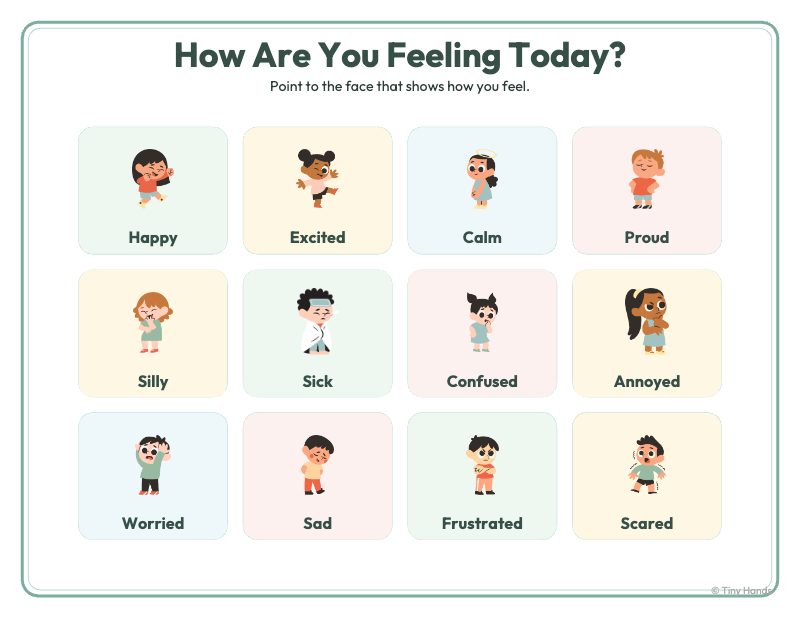
Can't find the words yet? Hand over crayons and let them draw today's "weather" instead. A scribbled thunderstorm says plenty, no sentence required — and it pairs perfectly with our feelings chart for kids for the days they'd rather point than talk.
A picture is a feeling word tooOnce a kid can name what's going on, pairing it with a calming skill helps even more — we go deep on playful, no-pressure ways to help a preschooler actually name a big feeling in how to help kids name their big feelings.
Heads up: this post has Amazon affiliate links. If you grab something through one, Tiny Hands earns a small commission at no extra cost to you — it's what keeps the free worksheets free. Thank you!
The feelings cards that give kids the words
Fifty cartoon faces with a coping idea on the back — an easy, no-prep way to help a child point to how they feel when the words won't come, at home or on a classroom rug.
The read-aloud for the kid who melts down over mistakes
The Girl Who Never Made Mistakes is a gentle growth-mindset story for perfectionist kids — a lovely one to pair with the "read it, then act it out" idea above.
When to Check In With an OT
Big feelings that are hard to manage are part of being a kid — emotional regulation is a skill that's still under construction well into the school years, and every stage on that chart above is completely normal.
That said, it's worth a friendly chat with an occupational therapist if a child's meltdowns are frequent, intense, and lasting well past the age you'd expect, if nothing on this list ever seems to help even a little, or if big feelings are getting in the way of friendships, learning, or family life most days. None of that means something's wrong — it just means that child's toolkit might want a little extra, individualized building.
This post is for learning and support — it isn't a diagnosis. © Tiny Hands