


How Do I Teach My Child to Open and Close a Zip-Top Bag? The Zipper Train Trick

Wondering how to teach a child to open and close a zip-top bag? Here's the short answer. Most kids can pull a bag open by age 3 or 4, but sealing it shut usually takes until about 5 or 6. The way to teach it is to have your child pinch the two edges at one end with both hands, then slide their pinch along the seam from one end to the other, like a little train on a track.
That's my Zipper Train Trick. It turns a fiddly, frustrating seal into one smooth movement your child can see and feel.
From the Tiny Hands shop
The Same Pinch, on Paper
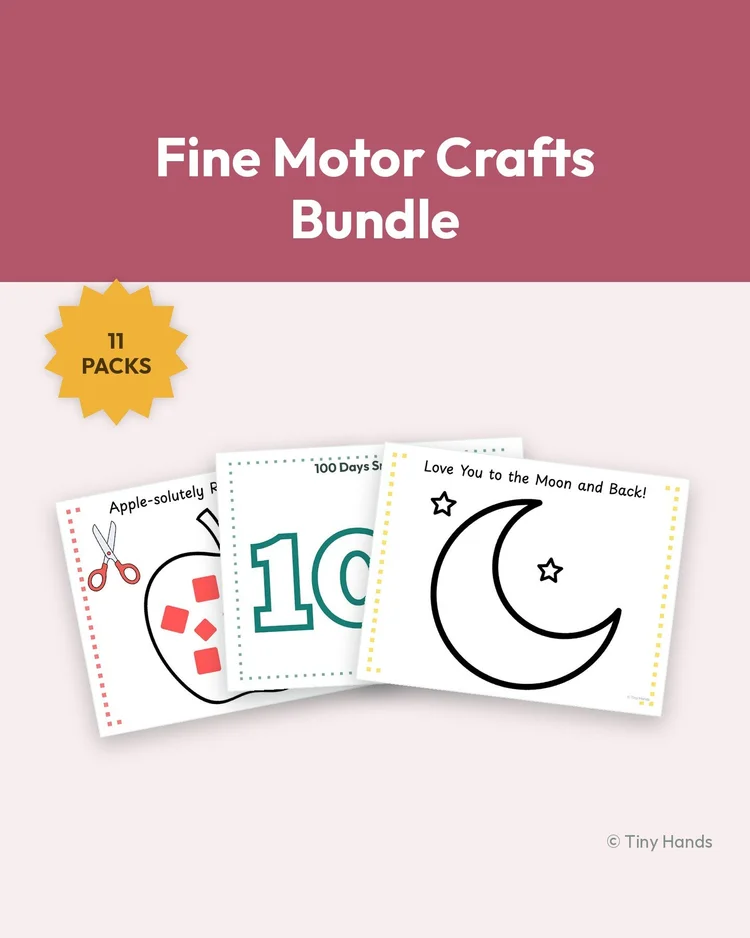
Sealing a bag is a two-hand pinch-and-pull job — one hand steadies, the other does the fine work. The Fine Motor Crafts Bundle drills that same teamwork through cutting, folding and sticking, so the hands get stronger between lunchboxes.
Shop the Fine Motor Crafts BundleAt What Age Can Kids Open and Close a Zip-Top Bag?
Here's the order I see in sessions. Treat it as a rough map.
Around 2 to 3: grab and yank
They'll grab the top and pull. Sometimes it opens, sometimes the crackers fly across the room.
Around 3 to 4: pulling apart with two hands
One hand holds each side and they peel the seam open. A zip-top bag that's a little loose helps here.
Peel openAround 4 to 5: the first sealed bag
They can get one end pinched and slide, though the middle usually gets skipped. Expect a "done!" and a bag that's very much not done.
Pinch + slideAround 5 to 6: sealing it without help
Lunch-box ready. Many kindergartners seal their own bag, give or take a stuck corner.
If your 4-year-old can't seal a bag yet, that's very normal. Those seams are tricky even for grown-ups at 7 a.m.
⭐ The Zipper Train Trick, step by step
Start with an empty bag. Crackers and sandwiches come later. Practice with the bag flat on the table so nothing spills.
Pinch the "station." With both hands, pinch the two edges at one corner using thumb and pointer finger. That's the train station.
Choo-choo along the track. Slide the pinch slowly to the other end, squeezing the seam as you go. Say "choo choo" if you like. It slows the hands down, which is the point.
Check the whole track. Run a finger back along the seam. Any gaps? Send the train back through.
Why Is a Zip-Top Bag So Hard for Little Hands?
A lot is packed into one little seam. Both hands have to do different jobs at once. The fingers need a firm pinch with just enough squeeze, and the eyes have to follow the seam so no gap sneaks through.
That two-handed teamwork is called bilateral coordination, and you can read how it builds in my post on bilateral coordination activities. The pinch itself is part of in-hand manipulation. And if lunchtime is a whole production, my lunch container post is a good companion.

How Can I Practice Sealing Bags at Home?
You don't have to sit down for a "lesson." Slip a bit of practice into stuff you're already doing.
Let them bag the snack
Pour crackers in, seal it, hand it to you. Real jobs beat pretend ones.
Real jobColor-bag fun
Put a dollop of finger paint or hair gel in a sturdy bag, seal it well (tape the top!), and let them squish and draw on it. They get the pinch without the pressure.
Treasure bags
Small toys go into a bag, then into the "treasure chest." Opening and closing a few times a day adds up fast.
For more ways to build the pinch at snack time, try my fine motor snack activities.
Want the printable version?
The fine motor activities in the Tiny Hands library build the pinch and two-handed teamwork behind zip-top bags, lunchboxes and handwriting. Print, grab a snack, go.
See the Fine Motor LibraryWhen Should I Check In With an OT?
Give it a few weeks of relaxed practice first. Plenty of kids take a while.
It's worth chatting with your pediatrician or an OT if your child is 6 or older and still can't open or seal a bag even with your help, if one hand seems much weaker than the other, or if lunchtime tasks lead to tears or skipping the food. An OT can spot which piece is tripping them up, and the fix is usually small. For more school-day independence ideas, see teaching kids independence at school.
Until then, a sealed-enough bag is a win. Pack extra napkins.
Grab the free Fine Motor Starter Pack 🎁
Join the list and I'll email you the free Fine Motor Starter Pack: 40+ pages of pinching, tracing, tearing and snipping activities you can print today.
Send Me the Free PackWant everything I use in sessions, sorted by skill? Peek inside the membership →
This post is for learning and support — it isn't a diagnosis. © Tiny Hands