


Do Fine Motor Activities Help Handwriting? What the Research Says About Playdough, Pinching and Practice

Do fine motor activities help handwriting? They build hand skills like dexterity, grasp and finger control, and many children enjoy them. But the research I found doesn't show that fine motor activities alone improve legibility or speed, and it points to handwriting practice itself as the better-supported route. No study I read tested playdough, tweezers or pinching as a stand-alone treatment, so part of this is inference from the closest evidence. Fine motor work can sit alongside writing practice, and it matters most when a child's hands are what's holding them back.
That might sound like I'm telling you to put the playdough away. I'm not. I'm suggesting you ask what the playdough is for. And if your child's OT has recommended hand-strengthening or other fine motor work, please don't stop because of this post; talk with them about how it fits with writing practice. Below: what the studies found, how I think about it as an OT, and how to spend limited practice time well.
What does the research say about fine motor activities and handwriting?
I'm describing these studies in broad strokes (see the note under Sources about what I could read). Who each study covered matters, so I've noted it.
A large meta-analysis of handwriting instruction
Santangelo and Graham (2016) pooled true and quasi-experimental studies of students in kindergarten through twelfth grade. Teaching handwriting led to moderate-to-large gains in handwriting legibility and fluency compared with no instruction or with non-handwriting instruction. Instruction aimed at motor skills did not: the abstract reports pooled effect sizes of 0.10 for legibility and -0.07 for fluency, close to zero. (The abstract doesn't spell out exactly what counted as motor instruction, and it likely isn't the same as playdough or pinching games, so this is the nearest evidence and not a direct test of them.) Individualized handwriting instruction and technology-based handwriting instruction did improve legibility. Handwriting instruction also improved the quality, length and fluency of students' writing.
Meta-analysis, mixed designsA systematic review of OT handwriting interventions
Hoy, Egan and Feder (2011) reviewed 11 studies of children with handwriting difficulties and concluded that effective occupational therapy for improving handwriting must include adequate handwriting practice. Interventions that didn't include handwriting practice were ineffective regardless of the type of treatment, and the abstract reports that programs with fewer than about 20 practice sessions were ineffective too. It is a small review of older studies, so I treat it as a consistent signal rather than a final word.
Some evidenceA more recent, more mixed picture
A 2024 systematized review of OT handwriting interventions for children from pre-K through third grade (20 articles, children without a specific diagnosis; posted by a university OT program and not a meta-analysis) sorted the approaches into cognitive, sensory-based, motor-based and multiple-component types and graded the evidence for each as moderate. All of the included studies reported improvement, though they used different measures. That includes the motor-based studies, so this review doesn't point the other way from the others; it simply doesn't rank the approaches against each other, and I can't tell from the summary what "motor-based" involved. Read it as "many OT approaches helped in small studies," not as a verdict on any one activity.
Limited evidenceSeveral skills relate to handwriting, not just the hands
In a one-year study of 106 kindergartners in Taiwan (Hwang and colleagues, 2024), spatial relationships, visual-motor integration and attention predicted parts of first-grade handwriting legibility. Manual dexterity was the one significant predictor of writing speed. This was Chinese character writing, and prediction is not the same as cause, so it can't tell us that training dexterity would speed up writing. What it does suggest is that legibility depends on visual and attention skills at least as much as on the hands.
One study, different scriptPut those together and the pattern is fairly consistent, with caveats: the studies cover different children and different programs, and "no clear effect in these reviews" is not the same as "no effect." Hand skills are part of the picture. But I found no good evidence that practicing them away from writing carries over, and fairly consistent evidence that practicing the writing does.
Why might fine motor practice not carry over to handwriting?
Handwriting is more than strong fingers. To write a letter a child has to know what it looks like, recall the right sequence of strokes, see and judge where to place it, and control a pencil while holding all of that in mind. Playdough and tweezers work on only one slice of that: finger movement, strength and control against resistance. In my experience, that slice is the bottleneck for some children and not for others.
That's why the same activity can be exactly right for one child and a detour for the next. The skill needs to match the problem.
How do I tell what's behind a child's handwriting struggle?
Looking at what the child actually does when they write usually tells you more than a checklist does. These are patterns I look for. They are clinical observations, not a diagnostic test, and a child can have more than one going on at once.
- Doesn't know how to form the letters. Starts at the bottom, switches direction, takes a different route each time. This is a teaching and practice problem first. See why kids start letters from the bottom.
- Can trace but can't copy. The visual-motor piece may be the limit. See visual motor integration.
- Letters are formed correctly but the hand is slow, tires fast or cramps. Grasp, in-hand manipulation, strength or endurance may be involved, and posture and the writing surface are worth checking too. This is where fine motor activities have the best case. See in-hand manipulation.
- Letters wander, float or vary in size. This could be visual-spatial skill, line awareness or the paper itself. A quick look at the page layout often helps.
- Writing falls apart as the task gets longer or harder. The demand may exceed current skill: spelling, ideas and legibility all compete for attention.
- Avoids writing or rushes. Fatigue, frustration, attention, vision or language load can all show up as "messy handwriting." Sorting out which one is the point of a closer look. Messy handwriting in kids goes through that reasoning.
The third pattern most clearly points toward the hands. The others call for teaching, practice, environment changes or an evaluation.

What should I do instead (or as well)?
The research doesn't give me an ideal number of minutes or sessions, so what follows is common clinical practice built on the findings above rather than a proven dose.
- Teach letter formation directly. Show the starting point and the strokes, say them out loud, and let the child copy. Use one consistent method so the child isn't relearning at home what they learned at school. If you're picking a program, how to choose a handwriting program compares what to look for.
- Keep sessions short and frequent. A few focused minutes most days is a sensible starting point, but keep it going for weeks: the Hoy review found programs with only a handful of sessions didn't work. Stopping while the writing is still good may help, since practicing tired, sloppy letters can reinforce them.
- Give feedback on one thing at a time. "Your lines start at the top today" lands better than a list of everything to fix.
- Make writing worth doing. Grocery lists, labels, a note to a grandparent, a menu for pretend restaurant. In my experience, purposeful writing gives children a reason to practice. (The studies above tested handwriting instruction, not this kind of writing specifically.)
- Use fine motor work as a warm-up or a targeted support. A minute of squeezing or pinching before writing is fine, though I'm not aware of strong evidence that it changes the writing. For a child whose hands tire quickly, spend a little time on hand skills in addition to writing, not instead of it. Fine motor warm-ups and hand strengthening exercises are ideas for that, and I'd treat them as support rather than a fix.
A quick test for any activity
Ask what skill it's building and whether that skill is what's limiting this child's writing right now. If the answer is "I'm not sure," watch them write for a few minutes first. If the activity is eating the time that writing practice would have used, trade some of it back.
How do I adapt this for different children?
- Preschoolers and younger children: this is where play with dough, clay, blocks, scissors and markers earns its keep. None of the studies above looked at preschoolers. These children aren't doing formal handwriting yet, and building general hand skills and enjoyment of mark-making is a reasonable goal on its own terms. There is no need to rush to worksheets.
- Kindergarten through early elementary: shift the balance toward letter formation and writing, with fine motor work in a supporting role.
- Children who get frustrated or avoid writing: keep writing tasks tiny and successful (one line, one word), let them choose the topic, and consider whether the demand is too high. A different tool (a thicker pencil, larger paper, a slant surface) may help some children, though the evidence for most of these is mixed. Do slant boards help handwriting? goes through one example.
- Children with significant motor or learning differences: they may need an individualized plan and different goals, including tools or alternatives to handwriting. Handwriting practice is still part of the picture for many, but the right dose and approach should come from someone who has seen the child.
- At school: teachers can build brief, consistent handwriting practice into the day rather than relying on a separate fine motor center to fix it.
What mistakes do people make with this?
- Assuming every handwriting problem is a hand-strength problem, and buying a gadget for it.
- Waiting until the hands are "ready" before letting a child write. Many OTs see writing practice as part of how hand skills develop, and early scribbles and letters count as practice.
- Turning fine motor activities into homework that competes with play. If it's not fun or purposeful, it probably isn't doing much.
- Treating "messy" as one problem. It's a description, not a cause.
Picture a first grader (a made-up example) who fills beads onto strings happily every day but whose letters still start from the bottom and drift off the line. More beads probably won't change that. A few minutes a day of starting each letter at the top, with a light visual cue for the line, is more likely to, and the beads can stay as a fun extra.
From the Tiny Hands shop
The Whole Path to Handwriting
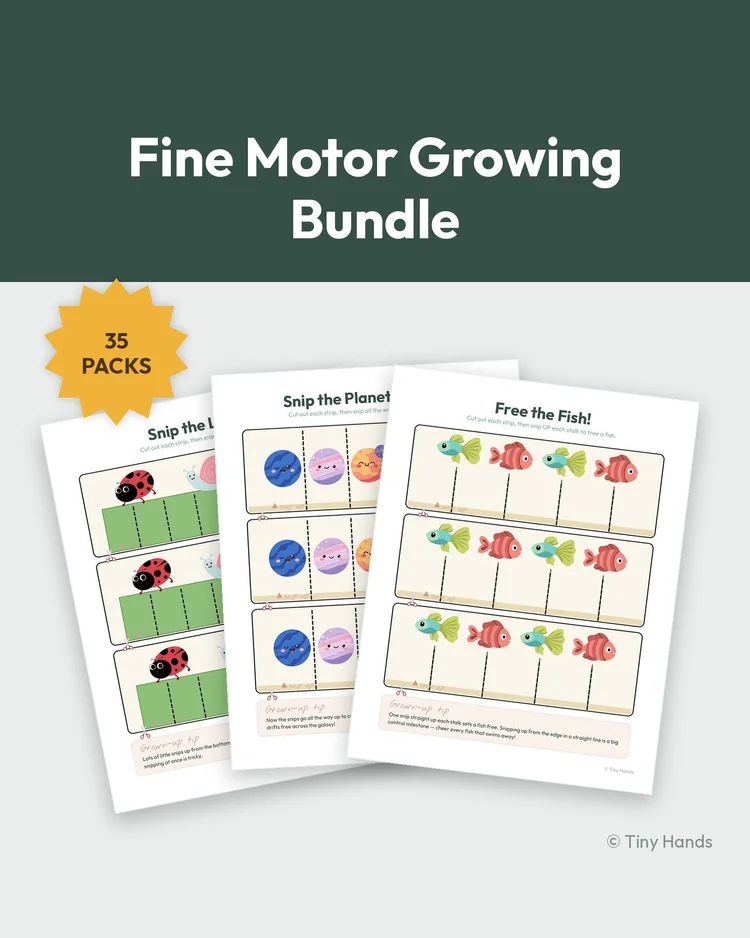
The research keeps pointing at the same thing: hands get ready for writing through cutting, pinching and tracing long before letters show up. The Fine Motor Growing Bundle walks that whole path in order, from first snips and strokes through to handwriting paper, so you are never guessing what comes next.
Shop the Fine Motor Growing Bundle
Would You Rather Cards
Want writing practice that doesn't feel like practice? The membership has Would You Rather Cards, writing prompts that give a child something to say and a reason to write it down. They're a practice activity, not a treatment.
See the MembershipWhen should I ask for an evaluation?
Consider talking to your child's teacher, pediatrician or an OT if handwriting is causing pain, or is getting in the way of schoolwork or confidence, if a child seems to be falling further behind their classmates despite regular practice, or if you notice a loss of skills they used to have. Other hands-on signs such as difficulty with buttons, utensils or scissors can be part of that conversation. An OT can watch the child write and work out which of the factors above are involved. In the U.S., whether a child receives school-based OT depends on the school's evaluation process and how their needs affect participation at school, so ask the school what the process is. School OT for handwriting explains what to ask for. Rules in other countries differ.
New here? Grab the free pack first 🎁
Join the list and I'll send you the free 40-page Starter Pack: print-ready pages to build hand skills and handwriting confidence at home and at school.
Grab My Free Starter PackWant the whole library sorted and ready? Peek at the membership →
This article is for education only. It isn't a diagnosis or individualized advice. If you're concerned about a particular child, ask a licensed OT or your child's doctor.
Sources
- Santangelo, T., & Graham, S. (2016), A comprehensive meta-analysis of handwriting instruction, Educational Psychology Review 28(2), 225–265 (abstract read)
- Hoy, M. M. P., Egan, M. Y., & Feder, K. P. (2011), A systematic review of interventions to improve handwriting, Canadian Journal of Occupational Therapy 78(1), 13–25 (abstract read)
- Johnson, C. P., et al. (2024), Occupational therapy interventions for school-aged children to improve handwriting outcomes: a systematized review, University of Nebraska Medical Center (summary read; an institutional systematized review, not a meta-analysis)
- Hwang, Y.-S., Hsiao, Y.-L., Su, P.-F., Hung, J.-Y., & Tsai, W.-H. (2024), Kindergarten visual–perceptual and motor skills and behavioral traits predict first-grade Chinese handwriting legibility and speed, American Journal of Occupational Therapy 78(1) (summary read)
Sources were read as abstracts and summaries; several full-text pages were not accessible to me, so details beyond the abstracts weren't checked. Findings are described in plain language and shouldn't be read as a promise for any one child.
This post is for learning and support — it isn't a diagnosis. © Tiny Hands