
Noise-Canceling Headphones for Kids at School: When They Help and When to Pause

Noise-canceling headphones for kids at school can be a reasonable, short-term support for a child who is truly distressed by loud or unpredictable sound, such as assemblies, the cafeteria, a hand dryer or a fire drill. The research is small and mostly done with autistic children, so I'd call them a tool worth trying for specific moments, not a proven treatment and not something to wear all day. Used with a plan, they may help some children get through moments that would otherwise be too much. Without one, there's a risk a child leans on them too heavily.
What does the research say about noise-canceling headphones for kids?
Less than the marketing suggests. The best-known study I found is a small one from a Temple University research group (Pfeiffer and colleagues, 2019). Six autistic children aged 8 to 16 wore noise-attenuating headphones, one week with over-ear headphones and one week with in-ear ones. A wristband measured skin conductance, a physiological marker of arousal. Readings were generally lower during headphone weeks than at baseline, though the pattern differed by headphone type and by measure. There was no control group and no behavior measures. Six of the twelve children recruited dropped out before the end, the design was single-subject, and the headphone maker supplied the equipment. The authors call it a proof of concept. No music was played, so the headphones only turned the noise down.
A 2025 laboratory study in Scientific Reports tested a prototype headset, tuned to each child's sound profile, with 7- to 12-year-olds, autistic and non-autistic. It lowered how unpleasant some everyday sounds were rated, but it did not help with fast-changing, tonal sounds like a car horn. It was a small lab study, not a classroom test, and the results may not carry over to store-bought headphones.
So where does that leave us? Two small studies hint that headphones may make some loud sounds less unpleasant and may lower physical stress markers for some autistic children. Neither tested real classrooms or everyday behavior, and I did not find controlled classroom trials showing that headphones improve learning, behavior or long-term sound tolerance. Noise-canceling electronics also seem to work better on steady sounds than on sudden ones (in the lab study above, the filter didn't help with a car horn), which matters because sudden sounds are often the problem.
Why is my child so bothered by noise?
"Sensory" is a common explanation, and sometimes it's right. But a few other things can look the same from the outside, and they point to different fixes:
- Fear of the unexpected. Some children are bothered less by the sound itself than by not knowing when it's coming. A fire drill is the classic case. In my experience, warning and rehearsal matter as much as blocking the sound, and the school should agree a drill plan with you that includes whether your child wears protection. Fire drill anxiety has its own plan.
- A genuinely loud room. Classrooms can be hard on everyone. ANSI S12.60 is a voluntary U.S. classroom acoustics standard that sets a limit of 35 decibels of background noise and 0.6 to 0.7 seconds of echo in an empty room. In a study of London primary schools, noisier occupied classrooms were associated with lower test scores, which can't prove cause and effect, and a separate experiment found classroom chatter hurt reading and spelling tasks most. So the room itself is worth checking.
- Hearing or ear problems. A child who has recently started covering their ears, complains of ringing, or has ear pain is worth a call to the pediatrician before you start a headphone plan. The American Academy of Pediatrics notes that pediatricians can arrange formal hearing evaluations for children with tinnitus or hyperacusis (an unusual sensitivity to everyday sounds).
- Fatigue, worry or a hard day. Tolerance drops when a child is tired, hungry, ill or already anxious. A child who copes with the cafeteria on Monday and melts down on Friday may not have changed at all.
- Sensory processing differences. Sound sensitivity is common in autistic children (Pfeiffer's group calls hyperacusis one of the most commonly identified auditory responses), and some other children have it too. It's real and worth taking seriously. It shouldn't be the default guess for every child who covers their ears.
I like asking the child first, in a calm moment: "Which sounds at school are the hardest? What happens in your body?" Their answer is better information than any checklist, and it tells you which situations need a plan.

How to try headphones at school without overdoing it
This follows school-team guidance from Derbyshire (UK) on using ear defenders, which is professional guidance rather than research, plus my own clinical habits.
Pick the moments. Aim them at specific hard situations: the lunchroom, assemblies, loud transitions, the bathroom with the hand dryer, a drill you can predict. The Derbyshire guidance suggests starting with about five minutes and then checking whether the child can manage with them off. If not, try another five.
Let the child run them. Keep them in reach so the child can put them on when they feel the need, rather than an adult deciding. The guidance notes that easy access can ease worry about triggers, though children still need chances to practice without them. Check that your child can use them safely before they're left to manage on their own.
Pair them with other supports. Give a warning before a loud event, pick a seat away from the speaker or the door, and offer a quieter place to eat or a calmer line. In my experience these can matter as much as the headphones, and they help the whole class. Our posts on cafeteria sensory overload and sensory-friendly classroom ideas have more.
Choose something comfortable. Fit and pressure matter. A pair a child hates wearing won't help, and some children dislike the feel of anything on their ears. Noise-canceling electronics aren't required; plain earmuff-style defenders reduce sound too, and may do as well for sudden sounds. Ask your child's team which kind suits the situations you've named. For younger children, the AAP cautions that earplugs can be a choking hazard and recommends over-ear headsets or earmuffs for children with audio sensitivity, with caution for earbuds.
Skip the music. Headphones for sound relief and headphones for listening are different jobs. In the study above, no music was played. If a child does listen to music or audio, the AAP advises keeping volume low enough that they can still hear when spoken to, with regular breaks.
What to watch for, and when to pause
You're looking for the child getting through a hard moment with less distress, joining in more, and being able to take the headphones off. Here's what tells me to slow down and rethink:
- They're worn most of the day, or the child panics when asked to remove them.
- The child misses instructions, safety announcements or conversations with classmates. Headphones that block the teacher's voice during instruction trade one problem for another, so agree on when they're off. A child with a hearing, language or listening difficulty may find headphones during teaching especially unhelpful.
- Sounds the child used to handle now seem harder. The Pfeiffer paper notes, citing earlier work, that completely avoiding sounds can lead to increased anxiety. Derbyshire's guidance warns against a child living in a sound "bubble."
- Distress is growing even with the headphones. They won't help much if the distress comes from worry, pain or a medical cause, and fit matters too: a pair that pinches or draws teasing can add stress.
If a child is relying on headphones more and more, that's information, not failure. It may mean the environment is too hard, the anxiety needs its own attention, or an evaluation is due. The Derbyshire guidance describes gradual practice with difficult sounds at a pace the child controls, but how fast to go is a call for the child and the team, ideally with an OT's help.
Asking the school
Some schools allow headphones case by case, and some write them into a support plan (in the U.S., through an IEP or 504 plan, which is the child's team's decision). Whether a school has to provide or allow a particular support depends on the country, the district and the individual child's needs, and having a sound-sensitive child doesn't automatically qualify them for services. A simple note to the teacher naming the situations, the plan (when they go on, when they come off) and how you'll review it gives the team something concrete. Talking to the teacher about sensory needs has wording you can borrow.
From the Tiny Hands shop
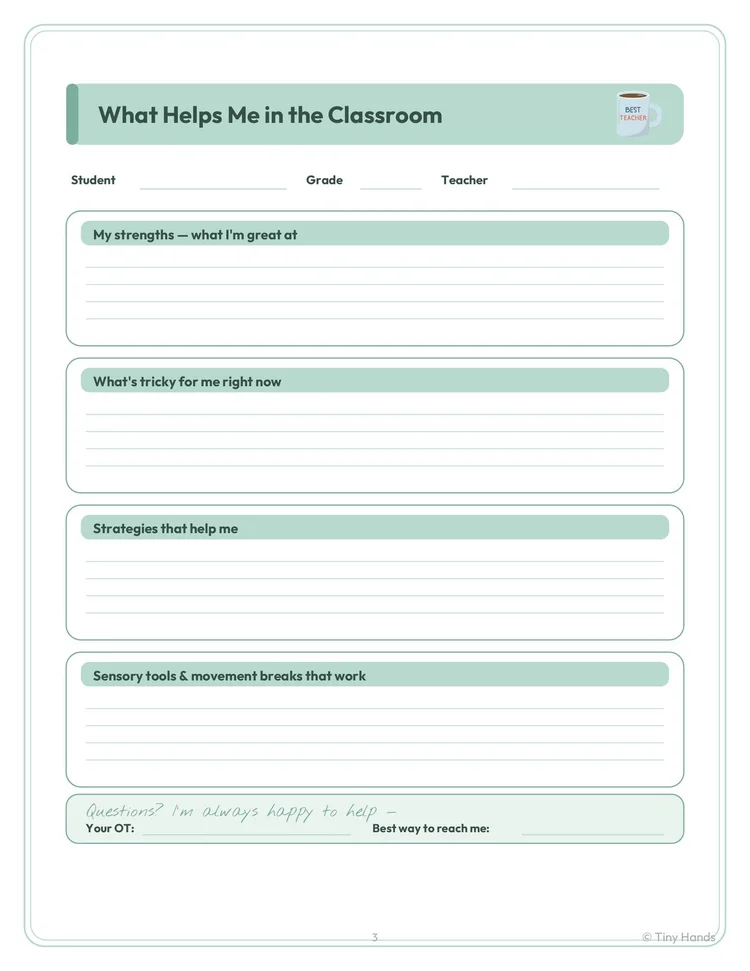
Hand the Teacher the Short Version
Most of what helps a noise-sensitive kid at school is small stuff a teacher can do in five seconds — if they know about it. The Teacher Strategy One-Pager puts it on a single page you fill in and send in, so the plan travels with your child instead of living in your head.
Shop the Teacher One-PagerWhen to ask for an evaluation
Talk with your child's pediatrician, and ask about an OT evaluation, if your child's reaction to sound is keeping them out of school activities or meals, if distress is intense or getting worse, or if it comes with other changes in sleep, eating or mood. Mention right away if there's ear pain, ringing, a change in how well your child seems to hear, or a sudden new fear of sound, and ask whether a hearing test makes sense. Those are medical questions first.
New here? Grab the free pack first 🎁
Join the list and I'll send you the free 40-page Starter Pack: print-ready pages to build hand skills and handwriting confidence at home and at school.
Grab My Free Starter PackWant the whole library sorted and ready? Peek at the membership →
This article is for education only. It isn't a diagnosis or individualized advice, and it doesn't replace an evaluation. If you're concerned about a particular child, ask a licensed OT or your child's doctor.
Sources
- Pfeiffer, B., Stein Duker, L., Murphy, A., & Shui, C. (2019), Effectiveness of noise-attenuating headphones on physiological responses for children with autism spectrum disorders, Frontiers in Integrative Neuroscience 13, 65
- Kwong, T.C. et al. (2025), Intervention technology of aural perception controllable headset for children with autism spectrum disorder, Scientific Reports 15, 5356 (laboratory study of a prototype)
- American Academy of Pediatrics (2023), Preventing excessive noise exposure in infants, children, and adolescents (HealthyChildren.org summary of the policy statement)
- Derbyshire County Council, Sensory Processing Needs toolkit: use of ear defenders (local professional guidance, not research)
- Shield, B. & Dockrell, J. (2008), The effects of environmental and classroom noise on the academic attainments of primary school children
- Hands & Voices, Implementing classroom acoustics standards (describes ANSI S12.60 criteria for unoccupied classrooms)
Sources were read as web pages, abstracts and summaries, not always full journal texts. Findings are described in plain language and shouldn't be read as a promise for any one child.
This post is for learning and support — it isn't a diagnosis. © Tiny Hands