


How Do I Teach My Child to Put the Cap Back on a Marker? The Listen-for-the-Click Trick

Wondering how to teach a child to put the cap back on a marker? Here's the quick answer. Most kids can pull a cap off by age 3, and can line a cap up and push it on with one hand holding the marker and the other holding the cap somewhere between 4 and 5. Teach it by having your child hold the marker still in one hand, the cap in the other, bring the two together in the air, and push until they hear a little click.
That click is my whole trick. I call it the Listen-for-the-Click Trick, and it gives kids a way to know they've done it right without anyone telling them. Back-to-school season is when dried-out markers pile up, so it's a perfect time to teach it.
From the Tiny Hands shop
Give Those Markers a Job
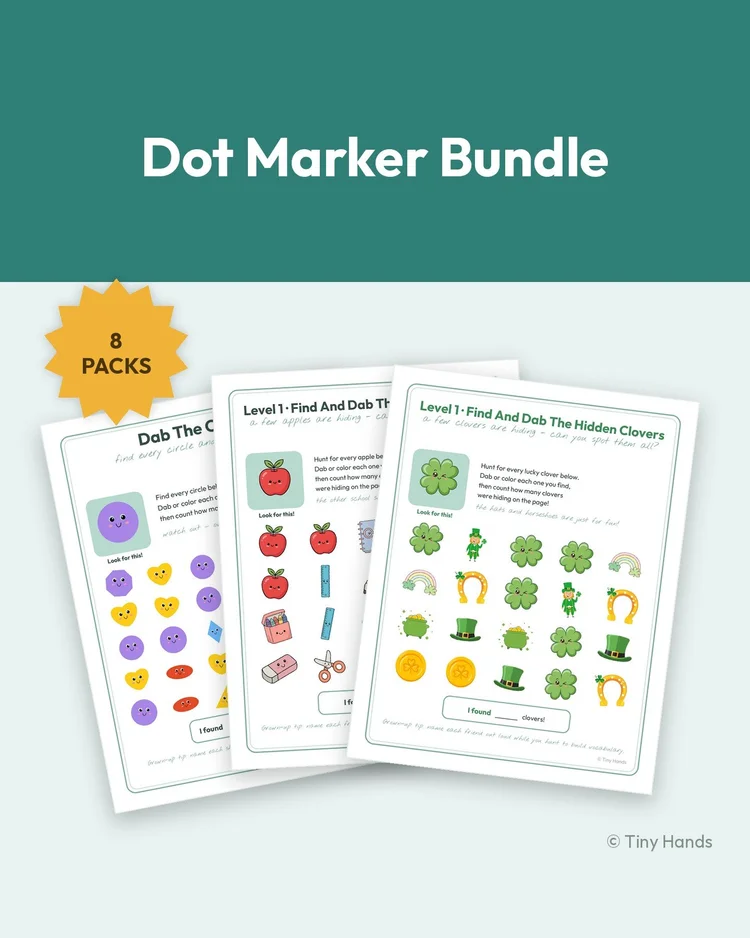
Capping a marker is a two-hand, line-it-up-and-push task — and the more marker mileage they get, the more automatic it becomes. The Dot Marker Bundle is a year of dot-marker pages, so the caps come on and off a hundred times without anyone calling it practice.
Shop the Dot Marker BundleAt What Age Can Kids Put a Marker Cap Back On?
Here's the order I see in sessions. Treat it as a loose map and not a checklist.
Around 2 to 3: pulling the cap off
Pulling is easier than pushing. Most little ones love yanking caps off and then losing them under the couch.
Pull offAround 3 to 4: cap on, with some wobble
They try, the cap lands crooked, and they push anyway. Sometimes it works, sometimes you hear a very dramatic sigh.
Two hands, a few triesAround 4 to 5: lining it up
Now they can hold the marker steady, aim the cap, and push until it clicks. Messy sometimes, and that's fine.
Aim + clickAround 5 to 6: it's automatic
Caps go on without looking, even while chatting with a friend. Your kindergartener may even remind you.
If your 4-year-old still gets frustrated, don't worry. Plenty of kindergartners are still working on this.
⭐ The Listen-for-the-Click Trick, step by step
Rest both elbows on the table. A steady base makes aiming so much easier.
Marker in one hand, cap in the other. Hold them in the air in front of the belly button, tips pointing toward each other.
Say "find the hole." Eyes on the cap opening, then slide the marker tip in.
Push until you hear the click. No click, no done. Kids love having a sound to chase, and you can stop saying "is it on?"
Tap it on the table. One tiny tap tells them the cap is really snug.
Why Is It So Hard for Some Kids to Close a Marker?
It looks tiny, but a marker cap asks for a lot at once. Both hands have to work as a team while the eyes guide the aim, and then there's enough finger strength to push. That teamwork between hands is called bilateral coordination, and it grows with practice.
If caps keep sliding off the tip, my post on bilateral coordination activities has easy games to build that two-hand teamwork, and in-hand manipulation activities covers the small finger moves underneath it.

How Can I Practice Marker Caps at Home?
Keep it playful, and let them do the work. A few minutes before coloring is plenty.
Marker garage
Draw a cardboard box "garage" with a marker-sized door. Each marker has to be capped to park inside.
Cap to parkClick race
Count how many clicks they can make in a minute with a fresh set of washable markers. Silly, but it works.
Feed the caps
Put the cap in a muffin tin, marker in hand, and let them practice "finding the hole" with eyes closed, then open. Great for aim.
Aim + feelStrong little fingers help too. My hand strengthening exercises for kids are easy to sneak into your day.
Want the printable version?
The pre-writing worksheets in the Tiny Hands library give those marker hands plenty to do. Print, grab a marker, cap it, go.
See the Pre-Writing LibraryWhen Should I Check In With an OT?
Give it some relaxed practice first. Most kids get there with a little time.
It's worth a conversation with your pediatrician or an OT if your child is 5 or older and still can't get a marker cap on after plenty of tries, if they avoid markers and crayons because of frustration, or if one hand seems much weaker or clumsier than the other. An OT can see which piece is tricky, and the fix is usually small.
Until then, celebrate the click. Moving to the next marker is a small victory.
Grab the free Fine Motor Starter Pack 🎁
Join the list and I'll email you the free Fine Motor Starter Pack: 40+ pages of pinching, tracing, tearing and snipping activities you can print today.
Send Me the Free PackWant everything I use in sessions, sorted by skill? Peek inside the membership →
This post is for learning and support — it isn't a diagnosis. © Tiny Hands