
Best Shoes for Kids Back to School What an OT Checks in the Store

You're standing in the shoe aisle holding two boxes. One has your kid's favorite character and a price tag that made you blink; the other is beige and half the cost. Someone is telling you about arch support, your kid is lying on the floor, and school starts Monday. What actually matters here?
Take a breath — the best shoes for kids back to school are simpler (and cheaper) than the display wall suggests. Here's what I'd tell you if I were standing next to you: buy a lightweight sneaker with a firm heel cup, a sole that bends only at the ball of the foot, a thumb's width of room at the toe, and a closure your child can manage alone — velcro or elastic laces if they can't tie yet, real laces if they can. That's the whole list. Skip the tall stiff "support" shoes, skip hand-me-downs that are already molded to somebody else's foot, and skip anything heavy enough to slow down a run at recess. Fit and independence beat brand every single time, and a $30 pair that passes those four checks is a better school shoe than a $90 pair that doesn't.
When Should My Child Be Able to Put On Their Own Shoes?
This is the question that actually decides what you buy, because a shoe your kid can't fasten becomes your job four times a day. Here's the real timeline I use in sessions — and remember, these are gentle ranges, not deadlines.
18 months–2 years: takes them off (constantly)
Pulling shoes off is the first skill, and toddlers are extremely good at it — usually in the car, usually one sock too. Look for soft, flexible, lightweight shoes at this age; barefoot on safe indoor surfaces is genuinely great for building foot muscles.
Off before on2–3 years: pushes the foot in with help
Your child holds the shoe open, jams the foot in, and you finish the strap. Velcro only here. A little loop at the back heel makes a huge difference — it gives them something to actually pull.
Velcro only3–4 years: on independently — often on the wrong feet
Most kids get shoes on solo around three, and they'll be backwards a lot. That's completely typical and not a red flag. This is the perfect age for the sticker trick further down this post.
Wrong feet = normal4–5 years (pre-K/K): right feet, velcro on their own
By kindergarten, most kids fasten velcro independently and get the feet mostly right. This is your back-to-school sweet spot: buy velcro or elastic laces so nobody's kneeling on the gym floor at 8:05.
School-ready5–6 years: bunny-ear bows begin
Loops and first bows start showing up, usually wobbly and usually with a grown-up nearby. Keep velcro for school days and practice laces on the weekend, when nobody's watching the clock.
Practice at home6–7 years: tying independently
Most kids tie their own laces somewhere in this window. If you're not there yet, you're in good company — my full breakdown lives in when should a child tie their shoes, with the step-by-step method I actually teach.
Laces unlocked👟 My go-to trick: The Bend, Twist, Squeeze Test
You can screen almost any kids' shoe in about ten seconds, right there in the aisle. Bend it: hold the heel and push the toe up — a good shoe folds at the ball of the foot, where toes actually bend. If it folds in half in the middle like a taco, it's too floppy. Twist it: wring the shoe like a wet towel. A little give is fine; if it spins easily, there's not enough structure for a day of running. Squeeze it: pinch the back of the heel — that heel cup should feel firm and hold its shape, because it's what keeps the foot sitting straight. Then add the thumb check: with your child standing, press for a thumb's width between the longest toe and the end of the shoe. Bend, twist, squeeze, thumb — no salesperson required.

Velcro or Laces for Back to School?
Velcro, almost always — and I say that as someone who very much wants your child to learn to tie. A school day asks for shoes on and off for gym, the playground, sometimes the nap mat. If every one of those moments needs an adult, your child spends the year waiting for help instead of practicing.
My rule of thumb: velcro or elastic laces for school days, real laces for weekends — tying belongs at your kitchen table with zero time pressure, then it moves to school shoes once it's solid. And if your child is still fighting with straps well past five, the problem usually isn't the shoe; it's the two-handed teamwork underneath it, which my shoe-tying and fastener guide walks through.
How Do I Teach My Child to Get Shoes On the Right Feet?
None of these need a shopping trip. These are the five I hand to families on the first week of school, in the order I usually try them.
1. The sticker split
Cut one sticker in half and put a half inside each shoe, near the arch. When the shoes are side by side correctly, the sticker makes a whole picture. Kids fix it themselves without a single reminder from you.
Ages 3+2. "Make them kiss"
Teach your child to put the shoes toe-to-toe so they "kiss." If the toes touch and it looks like a smile, they're right; if it looks like a frown, swap them. It's a picture kids remember way better than left and right.
Ages 3+3. Sit on the stairs
Shoes go on so much easier when a child is sitting on a step with feet flat on the floor below. It steadies the trunk so the hands can do fine work — the same reason posture matters at a desk, which I get into in core strength for handwriting.
Ages 2+4. Beat the timer (once)
One round, one minute, only when everyone's in a good mood — and never on an actual school morning. Practice under pressure is a game; performing under pressure is a meltdown.
Ages 4+5. Shoes for the stuffed animals
Let your child velcro a teddy's shoes or thread a lace through punched cardboard. Same hand movements, zero pressure, and it doesn't count as "practice" in a kid's mind — which is exactly why it works.
Ages 3+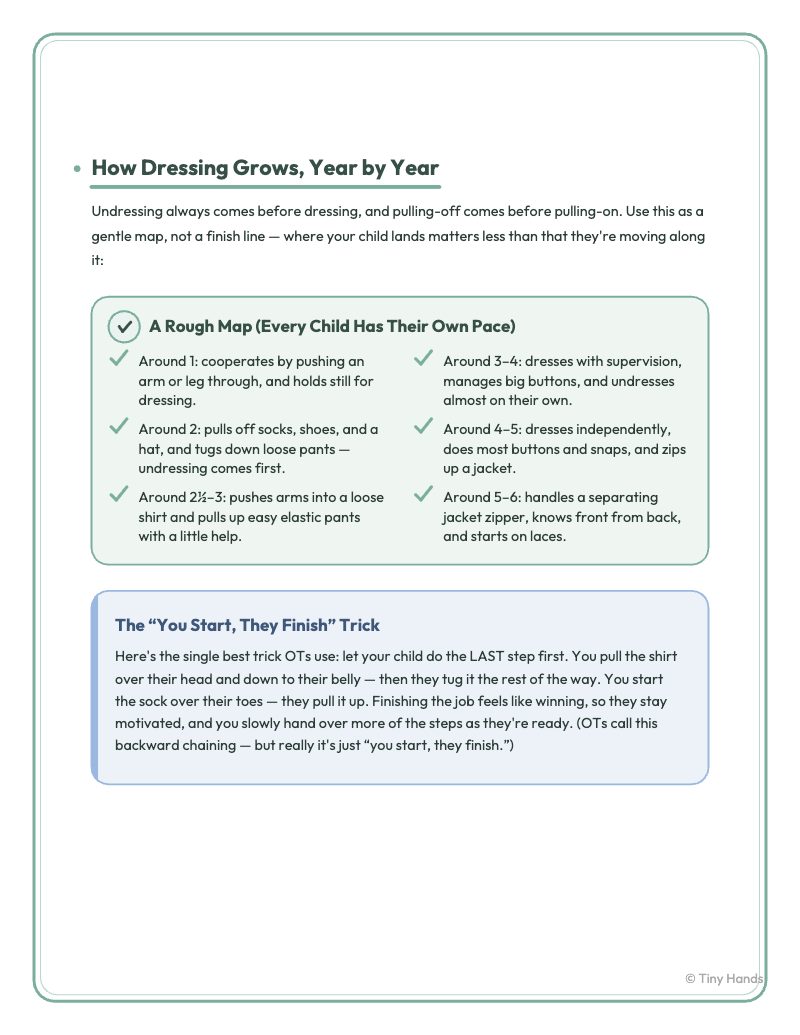
Want the Printable Version?
It's ready to print, right in the membership.
See Getting Dressed on Their OwnHeads up: this post has an Amazon affiliate link. If you grab something through it, Tiny Hands earns a small commission at no extra cost to you — it's what keeps the free worksheets free. Thank you!
The shoes a kid can actually get on by themselves
If you want a simple starting point that passes the checks above, these are the kind I point parents to: easy-close strap sneakers with a firm heel, a light flexible sole, and a wide velcro strap little fingers can grab. No laces to fight with at the gym door, and enough shoe to survive a real recess.
What Should I Skip at the Shoe Store?
Four things I'd walk past, gently: hand-me-down sneakers already worn into someone else's walking pattern (rain boots and barely-worn dress shoes are fine to pass down); tall, stiff "supportive" shoes that lock the ankle, since growing feet build strength by moving; heavy character shoes with chunky light-up soles that wear kids out at recess; and a size up to "grow into," which leaves kids tripping and curling their toes to hang on. A thumb's width is room to grow — two thumbs is a trip hazard. One free tip worth more than anything on the box: shop in the afternoon, when feet have swelled a little, so the fit is honest.
When Should I Check In With an OT About Shoes or Walking?
Almost everything on this page is normal kid stuff — wrong feet, slow straps, a strong opinion about which pair. Most kids sort out shoe independence between four and six with nothing more than practice and patience.
It's worth mentioning to your pediatrician or a pediatric OT or PT if your child consistently walks on their toes past age two and can't come down flat, if one shoe wears out dramatically faster than the other, if they trip and fall noticeably more than other kids their age, or if they complain of real foot or leg pain after normal play. It's also fair to ask for a look if they're around six and still can't manage velcro at all despite plenty of practice. None of that is alarming — it's a "let's take a closer look" flag, and looking early usually makes things simpler, not scarier.
New here? Grab the free pack first 🎁
Join the list and I'll send you the Fine Motor Starter Pack — 40+ print-ready pages to build those little hands at home, from first scoops to strong little grips.
Send My Free PackWant the whole library — sorted and ready?Peek at the membership →
This post is for learning and support — it isn't a diagnosis. © Tiny Hands